Silas' Season

It creeps up on me like the shadow of his absence.
I feel him first as a whisper breeze that cools a hot late summer day.
When a leaf leaves the tree, I fall with it
into piles of grief on the curb.
The suddenly incessant crickets every single night:
Exactly like his name in my head,
every single night.
The days tighten, losing light
as my heart constricts in anti-anticipation.
That moon, that September night, her labor and pain.
One by one, the leaves arrange into place.
The moon eases in its orbit.
The Universe rings my soul like a broken bell
when that perfect autumn eve
exactly captures the essence of the day he was born.
I cannot stand it once again
and once again I cannot move aside from the
drenching, gusting, cold fall storm
that is my face and heart and soul and hands
when his birthday is here
and he is not.

I have to settle for the fall.  For the piles I drive through.  For the crickets that sing their vigil.  For the cleansing rains.  For the chill of our loss on the last bits of summer heat, and the cold nights ahead where we have to hold each other close and let the spark of our souls keep his memory warm in our beautiful and broken hearts.

What does the season of your loss look and feel like?  Has it changed the way you view that time of year entirely?  Or are there other non-seasonal triggers that remind you of the day you lost your child?  And please feel free to offer a poem of your own, if you like.

Who was that?

When Catherine W. came into this community, I found her comments here and there, nestled amongst the others. Her insight and the haunting beauty of her words blew me away, and I wanted to know more of her story. It unfurled, moment by moment, through the months. Then, as though my prayers were answered, she began writing her blog Between the Snow and the Huge Roses. I think I speak for many of us when I say that it was as though her words were always here within us and around us, like the Poet Laureate of the Heartbroken. Her girls were born so early at just over 23 weeks, given impossible odds. One survived. One did not. She writes about that liminal place between lucky and unlucky, grieving and rejoicing and the intersection of all those emotions at the same time. I hope you join me in welcoming Catherine, as a regular contributor to Glow in the Woods. --Angie

One thing love and death have in common, more than those vague resemblances people are always talking about, is that they make us question more deeply, for fear that its reality will slip away from us, the mystery of personality.

From Swann’s Way -  Proust

I have to confess that I have not read any of the seven volumes of Proust’s ‘In Search of Lost Time.’ I don’t expect I will ever read anything that comes in seven volumes; life is short and time’s a-wasting. But my eye caught upon this quote in an interview with the novelist Francisco Goldman about his most recent book, Say Her Name. It is a semi-fictionalised account of the unexpected death of his young wife, Aura, in a freak surfing accident.

He summarised. The fundamental questions in death are: who was that person? Where did that person go? Who was that? And in love, it is the same: why does this one person, out of all the millions on the planet, suddenly merge with me so I effectively want to be her all the time? Why does this one person so enthral me? What is it? What was that? Who was that?

My mind, as it tends to when questions of love and death arise these days, immediately jumps to my daughter. Whose personality was, perhaps, more of a mystery than most.

When I have mourned the death of an adult, I have felt the tug of the specific. The particularness, the peculiarities of that person. And, when they have left, the question hangs in the air: who was that? I mull over characteristics and search through memories. With time, I have often gained some degree of resolution to that pivotal question, at least a partial answer.

But three years after my daughter’s death, this question is still keeping me up at night. Scratching my head in bewilderment. Wondering. Who was that?

photo by quinn.anya

My daughter. My half made girl. Whose brief life was so tentative and flickering.  Supported by whirling, whispering machines that gasped and kept time for her. This person who I am so in love with that I have tried over and over to inhabit her body, to live her short life. Imagined myself into that plastic box. Sometimes I even feel that it was me lying there, our identities have become so confounded.

Who was that? This person for whom I have been in mourning for nearly seven times as long as she ever lived. Already disproportionate according to some. But I suspect that multiplier is only going to increase. 

My husband and I were the only mourners at our daughter’s funeral and we were early.  We walked around the outside of the crematorium before the service. There were labelled spaces around the pathway, for the flowers that we hadn’t thought to bring. A space had been laid out for ‘Baby Georgina W.’ I couldn’t help wondering why she needed a qualifier.  Nobody else being cremated there that day had a preface. No middle aged man Joe Bloggs, no teenage girl Jane Doe. Only their names. But the babies, they all had that descriptor, a capitalised Baby, pinned to their fronts.

This type of loss has a nomenclature all of its own. It has qualifiers. Not just simple death. Miscarriage. Stillbirth. Neonatal death.  A different brand of death.  I still can’t decide if these terms are dismissive, diminishing, acting as a kind of Death Lite, or if they indicate that a death so very terrible has occurred that it needs to be somehow singled out. Death Ultra Ultra Heavy – handle with caution and step away as quickly as you can, thankful that this one isn’t yours to deal with.

Because the mystery of personality, the question ‘who was that?’ has a slightly sharper edge to it when a person whose life was very brief is under consideration. Sometimes I think the world at large cannot decide whether the loss of a baby is rendered insignificant by the brevity of their lives. Or made even more tragic, rendering the whole topic taboo.

That sigh, the exhalation that often comes when I add the qualifier ‘at three days old’ to the opening statement ‘my daughter died.’ That sound of relief that always seems to say to me, “oh phew, three days old, well that’s ok then. That is not as bad as the death of a three year old. Or of a thirty year old.”

Those words that so many of us have heard, “it’s not as though you knew her.” From the mouth of my doctor, a few weeks on, “It’s not as though you lost your husband. It could have been so much worse.” But he neglected to mention how to quantify the difference between husband death and daughter death and I was too sad to ask.

I ask, who was that? They say, why do you even ask that question, you couldn’t possibly know the answer.

My daughter’s life was very short and brutal, existing between the hazy ground of late miscarriage and the shadowy life sustained by maximal intensive care. A few short months in my womb, where I had barely started to feel her movements, followed by three days in the desperate world of the NICU.  My husband and I sat, craning forward over the desk, foolishly eager and optimistic, opposite the hospital consultant. He gently explained that there was nothing more that they could do, it was time to stop.

As she was dying, I felt I knew her in a way that I have never known anyone else. Perhaps because her entire life was spooling out in front of me, nearing its completion.  But I felt that she was not only the premature infant, dying in my arms. Her corporeal form shed away and she was simply . . . herself. At all ages and at no age at all. Looking back, I’m not sure how much of this experience was fuelled by post partum hormones and shock. But, at the time, I felt we had met. In a way that I have still not met either of my living children and, perhaps, never will. I hope that I will not see their lives complete, come full circle, as I did their sister’s. Time stretches their limbs and works on them, changing them inexorably and mercilessly. But not on her. The child who is, simultaneously, both the eldest and the youngest in the family.

In other circumstances where I have felt determined to get things right, to respond correctly, to inhabit the moment, weddings, birthdays, surprises, I have felt a veritable agony of self consciousness. And death is one situation where there is no ripping up and starting again. I was going to hold my daughter, just once. She was going to die, just once. And everything I had to say to her, everything I could hope to glean about her, everything I would ever know about her, well, that was the hour. It should have felt terribly pressurised. But, as my daughter slowly died, observed by strangers, I held her. And, amidst that strange calm, I felt that I knew her.

Do you ever ask, 'Who was that?' How do you answer that question? In what ways did you feel like you knew your baby(ies)? Or do you cringe even thinking about that question? Does it feel impossible to truly know a baby? How has that affected your grief and the ways you see your baby? 

Searching

When I first became acquainted with Josh's writing at his blog Jack at Random, I became immediately enchanted with the beauty and honesty in which he articulated his deep heartbreak. I grieved with him for his daughter Margot, who died March 24, 2011, after his wife fell and suffered a full placental abruption. In a blink, he lost his second daughter, almost lost his wife. The raw love, jagged and stunning, expressed in each sentence resonated so deeply with me. I found myself crying before I knew I was grieving for another. We are just so honored that Josh has agreed to join us here, as a regular contributor, sharing his journey as father and husband with us. Please help me welcome Josh to this space. --Angie

She was there for a time, in my arms, her cool cheek against my wet cheek, her pale forehead touching my forehead, her limp body held tightly against my chest.

Then she was off, in the care of impassive strangers, having open heart surgery to remove her valves for donation, taking little joyrides around Los Angeles between the hospital and coroner and crematorium.

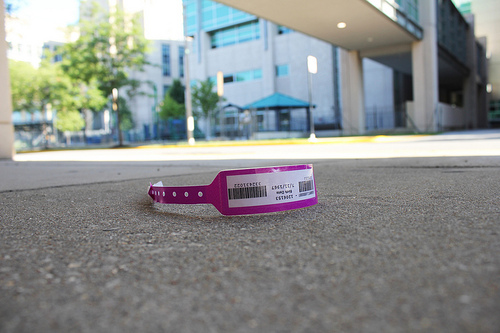
She arrived back to me in a little white canister, her name neatly typed in courier font on a small strip of paper: Margot June Jackson. Number 4-2389.  Cremated 03/31/2011.

And then she was in my sock drawer. She was partly there to protect us all from the possible awkwardness of others seeing her, and partly to protect us from the harsh reality that our daughter was suddenly reduced to ashes. For those few days before the memorial, I saw nothing in my house but the canister. I’d walk past mourning grandparents, step over my two year olds toys, eat dinner around a table and it was all just a blur. My daughter was in my house, in a canister, and I saw nothing else.

And then we took her into the woods and poured her into the river.

And then I couldn’t find her.

For if we find the deceased in our collective memories, where they still live on, cemented in photos and stories, how can we possibly find our babies? When memories barely exist, a few hours here, a few days there, how can they remain present? And when there are so few collective stories, passed on by those who knew and loved and touched the deceased, how will anyone else remember or find our babies?

Heaven would be nice, if I believed in such a possibility. It’s a comforting thought to think I could meet her one day again. Reincarnation would be nice too, the thought that she might resurface somewhere in the world, another chance at the tricky elusiveness of life.  But instead, my mind only allows what I can know without doubt. She died. We had her cremated. And we placed her ashes into the river.

Even still, I search and search, looking around every river bend, under every mountain rock and desert plant, on the metro and freeway, in the few pictures we have, in my fleeting memories, in my letters to her. But she is rarely there, always just out of my grasp, always still dead.

And yet.

As the months trudge on without her, as my search turns up empty, as the solitary moments I had with her slowly scatter to the far reaches of my memory, I’m starting to notice that as my grief evolves, I can find her from time to time.

Sometimes I find her in this new life that has suddenly emerged, one filled with desperate sorrow over her loss and sadness over a life that has become different than I always imagined. And in carrying these losses from day to day, I carry my daughter along with them. 

Sometimes I find her in the water, in the river where we said goodbye, in the ocean where she eventually ended up.

Sometimes I find her in this new company I’m now apart of, the society of the suffering. We have joined those who know and experience loss, whether close to home or far away. I find intimacy with them, with you, and in those moments, I feel close to her.

Sometimes I find her in new friendships, which have only formed because of her absence.

Sometimes I find her in my broken heart, the fragmented pieces that drip with sadness but also hold her very existence. Since I can never have her back, what’s better - a whole heart without her ever existing, or a broken heart with her dead? No matter how short her life, no matter how little time we had together, she is my second child. And I choose her.


Where do you find your kids? Do you find them in different places as your grief has evolved over the months and years? Do you find them at the grave, in your home or the spot where the ashes were scattered? Do you find your baby in a symbol?


short story


I have this idea for a short story.


Okay, this woman is sitting in the Perinatal Evaluation and Treatment Unit (PETU). Her husband is holding her hand. She keeps holding her belly and talking to it.

Be alive. She thinks, or maybe she says it out loud. She doesn't remember.

The couple trembles. They are on the verge of giggles. It embarrasses them both that anxiety reacts in them in this similar way. The nurse just listened to her belly with a heartbeat monitor and couldn't detect the heartbeat. She said, "This machine must be broken. I will get an ultrasound machine." The couple want to believe her, but something gnaws at them. It seems an unlikely coincidence that they would come in to find out if their baby died and the heartbeat monitor died instead, especially since they could hear the mother's fast, desperate heartbeat reverberating through the room.

The parents overhear the nurse ushering out the pregnant lady in the other bed. They tell her she will go to another room. The other pregnant lady had been arguing in Spanish on a cellular phone, but even she is quiet now. In the quiet without the woman and nurses, they both realize that the baby is dead, perhaps, or maybe their thoughts aren't quite that developed. But they both have the same impulse to protect the other, so they say nothing just yet about how the baby died and wait for a doctor. The mother's insides get all agitated, empty, nauseated. All turned upside down. Something is happening, her body tells her. It is something bad. It is something scary. Let's run. Let's go back home. They seem to think at the same time. Let's forget this ever happened. Let's yell at someone. Let's hit something. Let's scream.

The ultrasound machine is rolled in followed by a doctor, a midwife and two other doctors. It could still be alright, they seem to want to believe. Usually they don't need a team to hear a heartbeat, but when her baby's small form is shown to her on the small screen, curled in position, she can see there is nothing happening in her chest. It is still. So fucking still.

The mother says, "There is no heartbeat."

And the doctor says, "Yes. I'm sorry your baby passed away." And the mother will think later that is not a phrase that should be used on a baby. Babies die. Old men pass away. In their sleep. Because they are old and lived a good life. The life of this baby was ripped away from her body too early, too heart-fucking-breakingly early. She should have said your daughter has been murdered by Fate.

The medical team leaves them to process this information.


I know you know this story already, but hear me out. It is different this time. This short story I want to write. It is different.


They keen and howl and hold each other. The mother grabs her husband by the shoulders and says, "I'm sorry, but I am never having another baby again."  Then a nurse walks in to take them to the labor and delivery floor. The woman wonders if she can die now.

Can I just let go and die? I don't want to birth a dead baby. That is about the worst thing I can imagine. I never should have to go through this much physical and emotional pain at the same time. Just kill me, God, please just kill me.

"You cannot die right now, mama," the nurse whispers into her ear. It startles the mother to have her thoughts read so easily. She wonder if she has been speaking out loud, though she knows she would never speak those words aloud. The nurse is older, kindly, has a long salt and pepper braid running down her back. She looks familiar. So familiar. Then she realizes that the nurse is her. The nurse is the mother many years later, decades perhaps. She takes in this fact calmly. Clearly, she is in a nightmare. Or she is dead. Both of which is preferable to what is actually going down in the PETU. She turns forward again in the wheelchair.

Yep, that is me pushing me in a wheelchair about to give birth to my dead fucking daughter. It is so fucking cruel.

It is cruel, mother. All of this is cruel. It doesn't get easier, but it will become bearable.

Will it?

Yes. But like a bruise, it will always be tender, and it can easily become unbearable if you push on the hurt long enough, if you focus on the pain. But for the first eighteen months, you can do nothing but focus on the pain. That is right and good. Your daughter died. It deserves all your attention. Just don't try to die. Your family needs you. And you won't. You won't try to die. Just don't drink so dang much.

Yes, I know you are right. I don't want to kill myself, I just want to stop living.

That's normal. You won't feel like that forever. I promise.

The nurse rolls her into the room. The nurse is her, so technically, she is rolling herself into the labor and delivery room. It is like all L&D rooms.  The mother wonders how on earth she will bear to hear other women labor.

"We have you separated. You won't hear anyone else. All new mothers are taken to the other wing. Unless we fill up. But we do fill up tonight. You hear a baby being born at 5 in the morning. You actually feel joy the one time you hear a mother birth a screaming baby. You are happy for them. Don't worry. We have marked your door with a lily. It is so others will know that there is to be quiet in this room, solemnity, respect. We are all mourning with you here."

"I just wondered what happened with that."

"I know. I know everything that is going to occur to you. What you are thinking, what you are feeling, what will happen. I am here to guide you through this birth. To help you know what the future looks like under your own devices. I am the Ghost of Birthing Dead Baby Past."

"I think you need a new name."

"You will think it is funny in a couple of years."

And through the night and next day of delivery, the nurse tells her about what her life will be like. She says, "Have your mother come to hospital. Ask her to bring your daughter. It is important. It seems like too much right now to deal with a twenty-one month old, but it keeps you up at night that you denied your daughter the privilege of meeting her sister. It is too much to bear that they never met."

Later, the nurse rubs her feet  through fleece hospital footies during the earliest pangs of pitocin-induced contractions. "Don't be afraid of seeing your daughter. You are so terribly afraid of that through all of your labor and you forget about those fears the second you see her. She is beautiful. You see her bruises and it disturbs you, but you also see only her beauty, your nose, your hair. Take off all her clothes, kiss her feet. Take many more pictures than you think. Call Now I Lay Me Down to Sleep. I will find the number."

When the mother begins reading the grief packet, the nurse walks in with ice chips. "When you write the email entitled "Some Sad News," you ask people not to send flowers, or call for a week because a grief therapist told you to write that. Don't. Just tell your news. Don't tell people how to honor your loss. Because people read that as you never want them to call or give you any meals, or send any flowers, and they don't. Not ever again."

Later, after the mother rings for another pillow, the nurse leans in and whispers, "Don't tell anyone in real life about your blog. Ever." She fluffs the pillow and kisses her forehead.

As she is reaching the point of being fully dilated, when her husband and sister go out for some food, and leave her with the television, the nurse walks in. She sits on the edge of the bed and grabs her hand. "You are much more vulnerable than you admit or than anyone thinks. But you are also as strong as everyone believes, and so I must be honest right now. In the next year, you will feel abandoned. Your friends will walk away. You will feel righteous indignation at the injustice of it and you won't call them. Be the bigger person. I'm sorry to tell you that your daughter's death entitled you nothing, not even space to be an asshole. Some people, people you like, will never forgive you for not reaching out to them. You will miss them."

When the baby is born, the nurse cries with the mother. She holds the baby and kisses her again and again. She weeps and screams. More than the mother who is staid and uncrying. The nurse baptizes the baby and the mother in tears. But the nurse is also full of joy. The mother watches in amazement and silent admiration at how she can so easily move between these emotions. The mother feels absolutely numb, just numb.

"Lucia," the nurse says to the mother, "is always missed, mama. Smell her up. Hold her. Talk to her. Be her mama in the next few hours. This is all you get. You can't fully process that right now, but mother this baby." She hands the baby back to the woman. Solemnly, the nurse leaves the room.

The mother holds her baby for a few more hours, doing all the things the nurse advised. Some time later, the woman walks out of the hospital without ever seeing herself again. Not ever.


Okay, maybe it is a novel.


If you were rewriting your story after finding out your child died, what would you change? What advice would you give yourself? What kind of peace do you think that would bring? Would you even want a future you to advise past you on your own grief experience? Would it be easier to hear it from a future you or a stranger?

Whale Song

The marine biologist said that the mortality rate for Orca calves is 50%. I looked for you, Orca mother. All around me on the boat, the others, those who simply don’t know, looked at your pod mates. Your brothers, your sisters, your aunts and your grandmothers breached and danced, hopping and blowing. They waived their tails, black and white seeming to dance in the sea.

You I knew, were below and far from dancing. When they lowered the hydrophone into the green water, I listened for you. I knew you must be there. I listened for your low tones. The sound of crying, if that would be a thing that a mother Orca could do.

We name your children at birth. We give them a numeric designation the first time we see them, and then we hold a lottery, a year after birth, to give your children common names. See – we give words to this thing, this idea, this tenuous truth: not everything that is born stays here. And I thought of your baby. I thought of this child that you carried for 17 months, that you birthed at 400 pounds. I thought of that silent moment. The silence forever more. So, I listened for you. I listened to you.

Tell me Orca. I am of the race that must see further and know more – we are perhaps both of this race, now. I am on my way back. I hear, I know that I have returned to the original place. The landscape looks familiar but I am changed. I think of your travels, the water you know and the waters you dream of. Tell me, these places you have known all of your life, are they different now?

I sit next to this man. He squeezes my hand when the captain announces that we were passing Gabriel Island. We thought, however fleeting of a child of our bodies and our hearts, but not of our lives. There was a single solitary moment. A quantum. Just as long as his life, when we remembered.

I wondered who did that for you. Who shares your quantum? You live in a pod structure, a matrilineal, matriarchical society. Your mate for those brief moments, did he share with you and you with him? Who is with you to mourn and comfort? You returned to your mother and your pod, and he to his, and will there be a moment when you tell him what was and is and could never be? Does your mother know of here and not? Do the Orca's around you?

And you humans. Are you, like all of us, in the most fundamental sense alone in your sorrow? Is there anything other than the ever present time that allows you to find your way back? And without that person next to you, squeezing your hand, tell me, what is your life like?

mute

Today we welcome a guest writer who is familiar to most of us in this community. If there is such a thing as an champion commenter and support person, Australian writer Sally from Tuesday's Hope would win the gold. She is often the first other babylost mama women meet when they begin blogging, and she offers equal support to people years out from their loss. Sally's first child, Hope Angel, was stillborn in August of 2008 after 41 weeks of pregnancy. In the almost three years since Hope's death, Sally has gone on to birth Angus, her twenty-one month old son, and is about to give birth to her third child. We are so honored to have Sally share her words and insight here at Glow in the Woods. -Angie

What to say, what to say? What on earth to say? What, in fact, is left to say?

Each time I’ve gone to put fingers to laptop, I’ve drawn blank. Mute. The loss of my baby, the safe arrival of my next one 15 months later and the pending arrival of number three has left me in a stunned silence. I feel I’m simply all out of words.

photo by garrettc.

When life chewed me up and spat me out one chilly August day three years ago, on the other side of the equator, where August equals cold, the first place I found myself in the land of dead babies was here, at Glow. A dear friend sent me a link about how to dry up your milk and I read the post, then every single other post on the site, given Glow was still relatively new then.

I didn’t have a space of my own to write. For the time being, all I wanted to do was listen, and observe. So that’s what I did. And this was the first place I found solace, the first place I felt less alone.

A few weeks later, finally realising there was no way out of this heinous club, I found the courage to comment. Then start a blog of my own. And the words spilled forth, each and every day for months on end. They would keep me up at night, whirring around in my head like a washing machine on spin cycle, and the only way I felt better about things the next day was if I got them out, coherently or otherwise, on to my blog. And the love and support I got back in those early days via comments, literally saved me. They kept me going.

Through the first six months of my grief, and the next nine months of my next pregnancy, I was a slave to the laptop. But since that pregnancy ended happily in November 2009, then raising my son and now growing the baby I carry within on this very day, I’ve struggled to know what to say or how to say it.

So it may come as a surprise to some that I’m a journalist by trade. I studied journalism at university and got a job in the field where I worked for the next 10 years or so before trying my hand at the baby making game. Initially, that was pretty unsuccessful, which is why I ended up here. Stillbirth, you bitch.

During my journalism training, my shorthand told me I was perfect for the profession because I was a “compulsive communicator”. I loved to talk, write, meet people, learn things and expand myself. I was a people person, through and through and making connections was what I did best.

But throughout my career, I never felt fully satisfied with anything I was doing. Or writing about. My journalism job ended due to the limited opportunity and abysmal financial reward and I moved in to the world of corporate communications, writing crap for big companies I cared little about. It sapped me of my drive and left me feeling empty about the career I had built and hoped to fall back on once baby making and child rearing was complete. I wanted to be able to write but about something I was passionate about, and make money at the same time. A pipedream, perhaps, but that’s ultimately what I was striving for. I just hadn’t quite figured out how to make it happen.

Enter the stillbirth of my first child at 40 weeks and five days after a perfectly boring pregnancy and bam, I finally had something I was passionate about and wanted to write about. And write I did.

My Hope was born on August 19, 2008 and I hadn’t yet turned the calendar over to September when I realised I’d spewed out, like hot lava, nearly 40,000 words of her story.

My house was buzzing with family, flowers kept arriving on my door step, but I sat on my couch, laptop at the ready and just poured it all out. People would bring me food and drinks and I just kept on typing.

I also began connecting. Commenting more. Reading more. Writing on my own blog more. Participating in this community more. And my inbox was full because of it. I made friends. Real life friends I’d never met, but we shared a common pain, and we bonded none the less.

The words, both written, spoken and read were what kept me afloat. I also purchased every single babyloss/stillbirth book I could get my hands on to sooth my soul with the more tangible style of words and filled journal after journal with the darker thoughts not really suitable for blog or email fodder. I threw myself in to the language of babyloss wholeheartedly. I was living and breathing it. Your words in, my words out, like a calming yoga breath. And that’s the main way I survived. I honestly don’t know how the women of generations before ours did it.

But now, three years on and just weeks (days?) away from the birth of my third child, my second pregnancy post loss, and I feel I’ve run out. My milk quickly dried up after my daughter died and my words have dried up now.

I’m sad. I miss her. I want her back. I still get angry. I still sometimes play the why me game, when I know I shouldn’t. I get jealous, but not as much. I feel tired. I hate that this is my life, but I do make the best of the life I have now. I still can’t believe this happened to me and I think part of me will always be in shock. But that’s really it. Round and round. Rinse and repeat. What really is there left to say?

Is it simply healing? Time? The birth of a subsequent live child, reinstating my role as an active parent? The due date of another, just 10 days after the third birthday of the big sister he or she will never meet? A combination of all of those things, or something else?

Even when talking about her to those in my real life, I struggle to get her name out. I get so choked up just thinking about her, thinking about what we went through that I worry if I let those tears out again, I might simply never stop crying. I have been referring to her birthday this week as “Friday” and not as “Hope’s birthday”, which is the more accurate description of what the day actually is. On “Friday” I don’t know what I’m doing. On “Friday” I think we’ll visit the cemetery. On “Friday” I’m not sure I’ll feel like catching up with you. It is no wonder people don’t know what to say or how to act around me anymore, when I struggle to get those simple words out myself, even to my nearest and dearest who know how much I still hurt from the inside out and who wouldn’t care if I cried an ocean of tears at their feet.

I update my own blog when I can, but I feel it is mostly out of obligation now, to let my readers know where I’m at. But the words don’t flow as freely now, and none of the thoughts seem as organic and pure as they once did.

I still read and comment every day but that’s about it. I’ve posted just six times this year. Yet I still have that desire to write and write about what I’m most passionate about. And that still is my daughter. But really, what else is there to say? She died and at least for now, my words might just have died with her.

Do you sometimes feel mute when it comes to talking or writing about the death of your baby? Did you reach a point where you felt there was simply nothing left to say? If you have a blog, how often do you post and how long do you think you’ll be able to keep it up for? Do you find it easier to talk than write, or vice versa?