Random walk

Why are we here? All of us, I mean, humanity? Philosophers have been at this for millennia. So have uncounted and uncountable others. What we call regular people. Happy, unhappy, kind, lonely, content, brilliant, sad, successful, lovely, mean-- all kinds of people.

I found my answer long ago. I would like to say that I found it in my freshman biology class, but I would probably be lying. I certainly met the concept there, but it wasn't until a few years later, when my work in the lab required me to consider its moving parts, or maybe not even fully until I started teaching, that the idea blossomed and made itself a home right in the center of my brain. It wasn't a particularly painful process, as major mental model reconstruction projects sometimes tend to be-- I must've been ready for it, ready for this unifying idea to bring together life and science. And even still I find this understanding, this answer to be both astonishingly simple and just a little bit subversive. Not in the sense that it challenges rules and order, but in the sense that it comes back to shift the question itself.
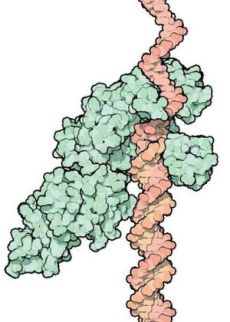
This. This sea green thing is my answer. A molecule, or, rather, a type of molecule. DNA Polymerase-- an enzyme, an incredible, precise machine, modeled here hard at work. What DNA Polymerase does is replicate (copy) DNA (there is a bunch of related molecules in the cell performing various components of this function, from straight up copying, to fixing particular types of errors that occur due to impact of specific elements of the environment, like for example UV rays from the sun; but since they all share the central feature I am talking about, I am going to talk about it here as if it's all one molecule). In the picture, DNA is the tightly wound thing in coral tones. In reality, it's the sourse of heritable information in the cell. In (almost) every cell in our bodies. In every living organism on Earth. (Viruses don't count-- they are not technically alive, since they need a host to proliferate. Viruses carry their genetic information either in DNA or in RNA, a closely related and most likely older molecule.)

To make a new cell, whether to grow and develop, heal a wound, or create a gamete for procreation, we need to replicate our DNA. Cells, you see, come from other cells. And the way they do it, roughly, is to copy DNA, segreagate it evenly to the future daughter cells, and pinch off the membrane in the middle to make two from one.

DNA is a double stranded molecule. But the beauty is that the information on how to make each strand is stored right in its partner strand. So if you separate the two (and there are enzymes to do that part as well), you can create two copies of the original by following the instructions in each of the single strands. Which is what DNA Polymerase, that sea green thing in the figure, is doing. You can see the single strand being single in brighter pinkish tones towards the top of the figure, continuing in the same color towards the bottom. But you can also see the new strand that the polymerase is making in duller orangish tones below the position where the polymerase is holding onto the strand the closest.

One last bit of science before I get to my point. The information on how to make the new strand is stored in the old strand very locally-- for each position polymerase is to fill in, the information on what piece needs to be put in is stored right across, in the corresponding postion on the old strand. This means that if it accidentally inserts a wrong piece, it should be able to sense it, delete it (via a different part of the molecule than the one that puts the pieces in), and try again. This is one of the mechanisms that makes the machine so accurate.

So here's the thing. DNA Polymerase is very very very accurate. Mindblowingly accurate. But it does make mistakes. Like once in a blue moon. But, our genome is about one third of a blue moon long. So it makes a mistake about every other time a cell's genome is replicated (because it makes two copies every time it replicates one cell's genome-- a new strand for each of the old strands).

These mistakes are not necessarily bad things. Sure, some of them cause cancer and other diseases, and some cause miscarriage. But a lot of them are entirely harmless, occuring in a region that doesn't seem to have a function, or changing only the way the instruction is written in the DNA, and not the instruction itself. And some of them are actually beneficial.

In fact, my answer to that first question, the reason we are here at all is "because of that very low rate of errors of DNA Polymerase."

For example, a long time ago there was no oxygen in Earth's atmosphere. Mostly sulfur. So first, due to some of these errors (and maybe other genome-changing variations, such as copy/paste of whole sections), some bacteria developed a system to use the energy from the sun to change carbon into the form that can be used for growth, using a sulfur compound to make the system go. Later, another bunch of copying errors allowed some bacteria to start using water instead of the sulfur compound in that system. That process produced oxygen. And since water was even more abundant than the sulfur compound, slowly, very slowly, the oxygen-making organisms occupied more and more space, making more and more oxygen, eventually changing our atmosphere into what it is today.

Many-many other changes occurred through the billions of years Earth has been around, both before and after the events I described above. Diversity of organisms populating the planet today, diversity within organisms, difference in the types of organisms living in one type of environment versus the other-- ultimately all of this is down to DNA Polymerase making those very few mistakes every couple of blue moons. If it wasn't for it making mistakes, there would be no humanity. To be fair, there might not even have been yeast. But very definitely no humanity.


And this is where I jump to the dead baby thing. Because while some of these errors allow new traits and whole new species to emerge, some of them cause miscarriage. Some of them cause birth defects, some extremely challenging and some fatal. This is why I am so very comfortable saying that there is no reason for why my baby died. It was random, shitty piece of luck. I don't know whether the particular things ruled to be the cause of his death were due to the actions of DNA Polymerase, some other part of cellular machinery, or environment interacting with otherwise ok parts of his or my biology that caused it, and in this sense it doesn't matter to me.

This is why I never ask "why us?" The scientific answer to "why us?" is, I know, "because of random events that occurred sometime during gamete production, fertilization, implantation, or development." The answer to "why me?" (if someone asks me to differentiate that from the "why us?" question) is "because he died, and I am his mother."


My philosophical/religious answer is also grounded in this scientific reality. "Why not us?" is that answer. Why should we be exempt from the luck of genetic, developmental, or environmental draw? I just can't see a Higher Being intervening in cellular processes. When my rabbi tried to say something about God calling A home for God's own reasons, I asked her not to say that again. Followed by "if God interferes in DNA replication or chromosome segregation, God needs a hobby."

Though this measured and cerebral part is not all of my answer, it is a lot of it. But there is also an incredibly strong emotional part. So strong in fact, that this is one of the extremely few topics associated with bereavement that is guaranteed to raise my blood pressure. (Not in the bereavement police kind of way, where I wish for everyone to share my perception-- I strongly believe in to each her own. But in the don't tell me how to see this kind of way, where I react strongly to anyone implying that the existence of reasons is an undisputed point of agreement among the bereaved, even if one doesn't know what those reasons are in each particular case.)

I could hardly talk to my mother about A's death for months after because she would inevitably end up at "why us?" again. When I finally turned on her to ask why the hell not us, she had nothing coherent. "Because we are such a good close family" is what she came up with. I laughed a long bitter laugh before asking her to please tell me what kind of a family did deserve to have a child die.

When Monkey was born, conceived after more than two years of trying, and after an early miscarriage, I decided that it is impossible to do anything to deserve having a baby. The happiness brought into our lives by finally getting a chance to love and care for and watch grow this tiny being, it was overwhelming. If you asked me then, I probably would've come up with the inverse, that there is nothing (or nearly nothing) one can do to deserve to have their child die. As is, I don't remember actually articulating this last part until after A's death.

Either way, that's where I am-- it's impossible to deserve to have a healthy child, and it's impossible to deserve to have your child die. And, to me, there is no reason. There is no reason good enough for a Higher Being to take your child. And any Higher Being who would disagree is not a Higher Being I want to have anything to do with.


And my final point. Human beings want explanations. And when we don't have them, we make them up. One thing we tend to do a lot is look at a sequence of events, like X happened, and then Y happened, and turn it into X had to happen so that Y could happen, an explanation. And sometimes, if you control for all other moving parts in the system, it is even true. But most of the time it's nothing but a logical fallacy. So I differentiate the things we do after our children die from anything having to do with a reason for why our children had to die. I see what we do after as things we do to learn to live with our tragedies or as we learn to live with our tragedies. Some of these things may be healing, some may be revolutionary and helpful to countless others, and many (most?) are just things we do to get through the days. But to me, none of these things are a good reason. To me, none of them are worth a baby's life.

The way I see it is we move forward because we have to. Putting one foot in front of the other. And sometimes what we do with the shitty hand we are dealt is incredible. Sometimes what we become in the aftermath is stronger and more beautiful than before. But to me, it's not a reason. And not an obligation, either. Just surviving is amazing. Early on, eating and doing laundry, and occasionally showering. Later, engaging in community, real life or virtual, caring about one's job, about politics, books, crafts, anything really. It's all amazing. And, to me, none of it an answer to "why us?"


Do you have bereavement-related topics that get you hot under the collar? For example, how do you feel about the "why us/me?" questions? Are your philosophical or religious answers influenced by your life experiences and perceptions and/or by your professional knowledge?

running on the spot

Inside is a mile-long glossy bar holding up various suits and skirts and a slew of dewy cocktails. The light is perfectly dim and golden, flattering. Our friendly Australian bartender has moved on after having slung us five perfectly mixed martinis of the pink variety. We cheers and clink, smile for a photo taken with someone’s Crackberry.

I end up at the head of the table. We’re sitting on the patio against a black glass wall that shows our reflections like a mirror in a darkened room. I see one, two, four faces sitting opposite each other, mostly blonde, mostly under 35. They’re gorgeous. Smiling, warmed and slinky as the vodka hits their systems.

I feel myself withering under the glare of their confidence. It’s an entirely familiar feeling.  I know with certainty that at least one of them will happily end up in the bed of a stranger tonight and I stare back at myself in the glass once again, wondering what the hell I’m doing there.

.::.

I imagine what Archie, Gabriella, and Ruby, the three other babies in our birth prep class, look like now. The ones who somewhere out there now walk and talk and giggle.

I think about their mothers, who I had grown so close to, so quickly. I had come to rely on them for distraction in the months leading up to Sadie’s birth. We would talk, drink tea, and eat cookies while we terrified each other with potential birthing scenarios. Once the kids were born we ventured out the first time together, navigating life with a tiny human attached to us, finally, on the outside rather than in.  In my mind they were the ones I’d happily spend my years in England closest to.

Of course I haven’t seen them since. My choice, not theirs.

.::.

I look around in silence while I wait for my husband to come back from the bar. It’s the pre-concert happy hour and I’m no longer sure my long cardigan and high boots are stylish now that I observe the wet-look leggings and gladiator heels. Everyone is magically 23, chins held high, their hair intentionally tousled and eyelids perfectly smokey. I’m astonished at the ease with which they carry themselves and in that moment I feel three hundred years old. Have I ever looked that carefree?  He hands me a drink and I can’t stop myself from thinking, “I could be singing a toddler to sleep at this hour.”  I should be.

I shake it off and concentrate on the story he’s telling me.

.::.

Every new situation I find myself in reminds me in some way of how different my life is from what I believed it would be at this point. As I find myself reliving the lifestyle I was once so happy to leave behind, I feel stuck.  I'm wedged between my life before and my life after what should have been. 

Where does the childless mother fit, exactly? We’re strangely and so reluctantly responsibility-free. None of it gives me the satisfaction I need. Yet I can’t seem to push myself to move in the one direction that would change all of that.  Knowing there's even a chance we could go through it all over again leaves me painfully idle, and angry at myself for not having the courage to move forward.

My crystal ball has apparently been lost in the mail.

.::.

How did you reconcile the person you were before your loss with the person you were forced to become?


why me?

Throughout the journey of losing my child, I have never asked myself, Why me?

Honestly, it’s just not a question I ask. Not because I wonder but won’t let myself ask. But because I could just as easily ask, Why not me? And because I already know the answer(s).

Why me? Because Tikva needed me as her mother, to love and hold her on her BIG journey.

Why me? Because there was a part deep inside me that was calling out – even if I didn’t know it – to be cracked open, stretched and expanded in this way.

Why me? Because even when I doubted it, Life knew I could do this.

Why me? Because I have boundless love and compassion – for my children, my family, my friends, in supporting others.

Why me? Because only through this could I become more fully me.

That’s not to say I wouldn’t trade it all in for a healthy, living Tikva toddling around me right now, nudging me off the computer and into a game of blocks with her. I would’ve been quite fine continuing on my way a bit less stretched, my soul less expanded, less fully myself.

But those are not the cards I got, and I want to remain in the game. So I’m making the best of the hand I’m holding now. As it turns out, I’ve got better cards than I thought.

***

I have wondered a lot if it’s all just about outlook, the color of the lenses on the glasses we choose to put on each day.

It’s easy when you’ve lost a child to go to that place of feeling like the person who got hit by lightning. What are the odds? In my case, they were somewhere between 1 in 2,500 and 1 in 5,000. That’s how often a child is born with a congenital diaphragmatic hernia. Me, I’m the one. 2,500 to 5,000 times more likely to be the majority, but this time I was the one. ONE.

It struck me sometime after Tikva died just how lucky I was that Dahlia, my first child, was born healthy and with no complications. What are the odds of that? One in how many? And my second pregnancy, which ended in miscarriage at 10 weeks – 1 in 4. Pretty high odds, but at the time I was utterly dumbstruck. Me? This happened to ME? I had to laugh about that when I learned that I’d made 1 in 5,000.

Back to outlook… I could look at that in so many different ways:

I must be the most unlucky mother in the whole world.

Someone out there must think really highly of me to be paying so much attention to my little self and giving me so many *$%@#! challenges.

What did I do to deserve this? Did I do something wrong?

The odds could be even smaller, I could be one in ten million.

The Universe is a random place, and shit happens.

Somebody has to be the one.

***

There is so much ego in this business of making sense of loss. So much ME in it all. So much of my busy mind trying to rationalize the irrational, comprehend the incomprehensible. Trying to fit something messy and confusing into a neat little container that can be shut and put away on a shelf, retrieved and reopened as needed.

I don’t think it works that way, though. I can put all of Tikva’s things – the physical reminders of her existence – in boxes in a beautiful wooden chest and keep it close by. But the meaning of it all – the WHY – isn’t so cooperative. And the answers don’t seem to come from my busy mind. From my ego.

Sometimes I ask Tikva…

Why me, Tikva? Because I needed you to hold me and look into my eyes and speak to me and kiss me, to lift me up.

Why me, Tikva? Because you are special, Mama.

Why me, Tikva? Because others will need your help.

Why me, Tikva? I don’t know, Mama, but I’m glad it was you.

***

I sat in a park in Jerusalem with Dave, just weeks before Tikva was conceived. It was sunny and warm and we lay in the grass under a tree.

I said to him, “I want to get pregnant.”

“When?” he asked.

“Now. Soon. This month.” It was just before Rosh Hashanah.

I was absolutely and completely sure. Ready. I had no idea why, but I was sure. Maybe Tikva was whispering in my ear. Maybe there was a part of me that was calling out, unknowing, for the journey ahead. It took us only one try.

If we had waited another month, would it have been Tikva? Would our child have been healthy? We didn’t wait another month. I don’t believe we could have.

Why me? Because this is my story. Tikva is my child. The only child I could have created in that moment in time.

It’s just not a question I ask myself, maybe because if it hadn’t been me, I would never have had a child like Tikva. And I would never have learned to love in quite the same way.

.::.

What are the questions you ask? Do you have answers? Where do the answers come from? How would you lost child(ren) answer your questions?

the land on which i stand

I am an Incognito Disaster.
You can't see the mayhem only millimeters out, but it's there, inside.

You can't see my toes curl as I cringe when I re-live the day Silas was born.
Cars swerve around my thoughts as I drive.

You can't hear the breath
the deep, deep breath
when you trundle in, laden with newborn and bags and Hope.

The Hope smells like crushed pine needles and jasmine covered in maple syrup, honey and soy.  It makes me sick to my soul because I can't swallow that anymore.

Today:
Pregnant lady holding the door for a n00b mom with n00born and they passed a look that gutted my heart.
From one:  "Oh how cute! (you don't know what you're in for.)"
The other, laden within: "I can't wait to be on that side of this  (bloated mess.)"

Wife sick of her pregnancy, Mother sick of her kids.  Father and To-Be on either side unaware of their peril.

From nowhere in their realm, from no vantage of their many views could they see me frozen nearby.  They cannot see the land on which I stand.  They cannot taste the ashes of my dreams despite their sudden sneeze.  To them, my flesh does not sag with endless despair.

I gasped and turned, gutted, I let them pass and flashed into everything each of them promised.
I burned with how bad everything can go, in an instant.
In a day.
In a night of pain and labor.
In a life or three or many, many more.
They should never know any of this and I hate how much we've had to learn.

I'm sick of learning.  I'm sick of fortitude and strength.  I'm sick of wisdom and grace and getting by.
I want to swallow the sunlight.  I want to consume Hope for breakfast and shit rainbows of beauty and joy.

Instead:
Creases in my cheeks from the tears & tears.

Instead:
Holes in my heart that I stare into thinking, sinking.

I lead a double life.  There's this one here alone with Lu and the impossible one with Silas, too.
Both are true, both are me.

I will never let either of them go.

I am a Disaster in Disguise.
I am a Master of the Lies I have to tell to get through the day.
I'm so good at it now, I sometimes even almost fool myself into being a little bit okay.

~~~~~~~~~~~~

Can you describe an instant of recognition or insight that surprised you or caught you off-guard?  How many lives do you lead?  Do you ever feel okay?  And are you okay with feeling a little okay, sometimes?

Foreign Language

During our kitchen renovation last year, we moved one of our favorite paintings out of the way, but stupidly not off the floor. And when the reno was done, we clearly didn't hang it back up fast enough because one day we discovered the glass had shattered.

My husband had given me a bunch of old maps of our neighborhood for Christmas '06 -- two months before Maddy died -- and told me the map store guy recommended a small, "doesn't really have a storefront" framer. Said he was the best in town. Of course, I never took my maps in, they just sat and collected dust, but I dug up the name of the framer when I needed my picture fixed two years later.

I called the number, and was greeted with a recorded message: he was currently scaling back his hours due to his wife's death. He left an email on the message, so I sat down and composed what I thought was a fairly simple note: You were highly recommended; I have this painting with broken glass; and I'm so very sorry to hear of your wife's death. I may have added a sentence that I understood completely the need to scale back hours, and realizing that I was a new customer anyway, I would come in at his convenience.

He called back within hours, and after arranging a time to bring in my picture, he said "Thank you so much for your words about my wife." I said again how sorry I was to hear of his loss, and he went on to tell me it was after a struggle with cancer. I asked how old she was -- in her 50s. Ugh.

When I went into the store, he had a small picture of his wife up on his desk. We chatted again, I asked how he was doing ("You're very understanding," he said appreciatively at one point), we talked about her battle. And then the story spilled out: as it so happens my house, for a few decades in the mid-1900s, was a school of sorts. He saw my address, and confirmed which house was mine, and it turned out he went to this school. He eventually taught at this school. He met his wife at this school, in the building that was now my home.

My heart broke in two. I invited him to please come over some time -- we'd love for him to walk around and point out what was where as he remembered it, and place some of the ghosts in their appropriate rooms. But to think, if I had not been so engulfed in my own grief, I would've made this trip much earlier -- two years earlier -- and they both could've come over and relived something together. For some reason I felt miserable. (During this entire discussion I never once mentioned Maddy, though I may have alluded to "a personal tragedy.")  We spoke some more, he fixed the glass on my painting, and I have yet to take in my maps. I need to call him.

:::

My mom was really quiet on the other end of the line. I asked how she was doing, and she said, "I guess I'm just getting used to the idea that my mom isn't here anymore." For some reason, I blurted out, "Grief isn't linear."

Which sounded too pat. So I started gently explaining that in my opinion (trying desperately not to sound like I had written this a million times in a million venues), that perhaps you went through the stages, but not with any rhyme or reason. It wasn't better, better, better every day until suddenly . . . . all done! You went through a stage, sometimes really fast, but maybe you circled back around and did it again a few months later. I pulled out my traffic metaphor: sometimes you're in the express lane, sometimes you find yourself stuck in traffic. You can be humming along only to make a turn and find yourself lost, or in a dead end.

"That makes a world of sense," said my mother. "Thank you."

:::

I discovered a neighbor's father had died during August, my personal month from hell with the endless houseguests and my own grandmother dying. I ran over a card on which I wrote (after saying how sorry I was) that I was looking forward to hearing some stories about his father the next time we got together. And to please call if he needed anything.

:::

I have given up thinking that I am to find or gain something positive from Maddy's death. It was brutal and ugly and senseless, and I've decided I really don't need any "silver lining" in order to move forward. Maybe it will slowly hit me one day, maybe not, and I'm fine with that. I've stopped looking or caring, in any case.

But some things have certainly changed in my behavior and mind's eye, and some of those things I would venture to say for the better.

I can now talk about death. I am completely comfortable talking to people now about all things grim reaper.

There is no way I could've had any of the above conversations prior to three years ago -- I would've been tongue-tied, perhaps mumbled an "I'm sorry," and maybe listened, but probably in hopes they would soon change the subject so I wouldn't have to. I remember standing around a funeral for a father, a distant relative, and being so crushed for his wife and children, and having absolutely nothing to say. Nothing. Seeing the vacant miles of space behind his teenaged-children's eyes, and not knowing how to acknowledge that I saw it, too. Just standing arms akimbo, feeling very lost and removed.

Now, I'm right there with them. I listen attentively, as long as they need to talk. I ask questions. I don't state platitudes. I am not so bold as to say I am empathetic -- I don't know cancer, I have never lost a spouse, my parents are still alive. I only have the briefest of experiences with dementia, and second- and third-hand relationships with hospice. But I know grief. I know the contours, the expressions, the varieties -- each with a differently shaped leaf. I can sense now when to simply be quiet, when people don't want to talk, and when they need to dump. I am no longer fearful or awkward around graveyards, or DNR discussions. I am no longer afraid when people cry. I know this. This I can do, for them.

I can -- usually -- rather easily feel what other babyloss parents are feeling, even if the circumstances are wildly different and their reaction is polar opposite from my own. I know the language now, all those words about "loss" and "never," "why" and "beautiful," but mostly "sad," "crushed," "hopeless."   Certainly it hurts to read of new deaths in some respects, but I feel a sense of obligation to bear witness to the stories, to roll the name(s) off my tongue, and simply (virtually) sit with the parent for a few moments. A few moments -- that's all it hurts me any more, but I know for them the moments will stretch and multiply and crawl until it seems they're drowning. It's the least I can do now that I know I can do it.

I abide.

Some would say this is a skill, or even a gift, that I didn't possess before, and I suppose I should be thankful and consider it a positive consequence to my own journey through hell. But there are days I wish I didn't have it, this ability to sit and be with death, and that I still felt fear, awkwardness, and taciturn bewilderment. Because it would mean none of this ever happened.

Have you experienced a death or another person's grief (outside of babyloss blogs) since the loss of your child(ren)? How did you handle it? How did it make you feel? Is it easier or harder or unchanged the way you acknowledge others' loss?