
The Older Sister

Sometime this weekend, while she is playing, or reading, or sleeping, or eating, or attending that second live concert in one weekend, or having tea with a real live writer (her aunt knows the coolest people), or working hard at improving her full turn or her free hip or her tuck, sometime in this weekend packed with so.much.fun she will cross a threshold she is not aware of, but I am. Sometime this weekend my daughter will have lived more than half of her life as a bereaved sister. I could calculate it exactly, down to the minute, really. But I don't let myself. I don't want to know that precisely.

This is a kind of thing my mind gets hung up on. I remember coming up on living (then) half my life in this country, and it seemed a big deal. My sister, who's eight years younger than me, and so reached the same point that much earlier just sort of shrugged-- she was so far past that place herself that it was no longer a thing for her at all. Thinking about that I wonder whether this will ever seem like a big deal to Monkey. I know she is not thinking about it now, and I don't know whether she ever will. She is, by nature, a storyteller, not a mathematician or scientist. And so it is not clear to me that even looking back from any place in her hopefully long and eventful life this invisible line will matter a diddly to her. She was so very marked by her brother's death itself that it might never matter to her that there was a time before it, or how much time that was.

She grieved. Oh, she grieved. Out loud and quietly. In her first language, the one we speak at home, and then, as she started school and her English improved and they started learning Hebrew, in two more. Like all of us, she is no longer in that acute all-encompassing phase of early grief. But neither has she dispensed with it. Which is, of course, as it should be. And, at the same time, as everything about this, it's too fucked up for words-- the kid's not yet ten, and she's lived with grief for half her life.

There are things about her that are undoubtedly shaped by her experience as a bereaved sister. It's not that she is somehow an expert at other's grief. But she has a fine sense of what is and isn't about her. She understands the shades of sad. When a beloved teacher in the school died suddenly and unexpectedly in December, she was sad, but she also understood with piercing clarity that hers was a sadness from a distance. She and a couple of classmates spent some time that afternoon writing letters to dead people, including the teacher. She let me read her letters.

She wrote four letters total-- one to the teacher who died, one to her brother, one to my grandfather who died before she was born and in whose honor she is named, and one to my grandmother who died in May and whose funeral was the very first Monkey ever attended. There is no sentimentality in any of these. There is no cuteness. There is no mixing of her issues in with the sadness of others. And that is why these letters (I kept them) get me still. She is not even ten, and she has this understanding that we all wish more adults around us had.

To her brother she says that she misses him still and loves him. She notes the age he would've been, and how she thinks her younger brother would've liked to have an older brother too. And, still, still, still, she says she wishes she could see him. Me too, kid, me too.

To my grandmother she says that she didn't really know her (true-- dementia is a horrible thing, and by the time Monkey could remember things well, my grandmother wasn't herself anymore; they did have a lot of fun earlier in Monkey's life, though, and for that I am glad), but that she knows how much her daughters miss her.

To my grandfather, and I must say that it surprised me that she wrote this one, she says that she is named after him and tells him that though it is very sad, his wife has died recently, and also that he is still very missed.

To the teacher she says that she is now very sorry she never really knew her. She was a middle school teacher, but she also had been involved in many things at the school. It was remarkable to me that Monkey understood the difference between how she knew the teacher and how the teacher's students knew the teacher. Monkey says that she is sure her daughters miss her (of course), but then she doesn't say that about the students. She describes, instead, what is happening near the teacher's room in the school-- there is a bathroom across the hall, and Monkey writes that the lower school kids are not allowed to use it because her students are in there-- they are crying and washing their faces, and crying, and washing, and on and on. I cried when I read that. I have tears coming up now as I write about reading that.

The mindfuck of this is that it's not that she is naturally fearless in the face of pain. She is sweet and she's always been kind, and she has a good deal of empathy. But she is not, and I know it is strange to say about a kid who hurls herself at the vault table and flies to execute her bar dismount, she is not naturally the most courageous person you've ever met. She is cautious and risk averse. And as we all know, death is a scary thing, and raw pain of a grieving person is perhaps scarier still. So the fact that Monkey is better than most at handling other people's grief is mostly about her own biography, her own story. It sucks. I am glad she is the way she is. I hate that she is that way because her brother died.

I heard it said about the senior rabbi of our congregation that because his father died when he was very young, he is drawn to comfort the grieving. Like a proverbial firefighter, he runs towards the grieving family when others are tempted to run away. Monkey is not like that. She doesn't run towards the grief. She might even hesitate, as she did about whether to attend my grandmother's funeral or about whether to visit her kindergarten teacher recently as she mourned the loss of her own elderly mother. (This was the teacher who helped Monkey find her voice in both English and Hebrew, the latter because at the time she was saying kaddish, Jewish mourning prayer, in the classroom every school day for her father, and entirely without prompting and without telling us Monkey joined the ritual.) But even in those cases, it takes but a short conversation, a few sentences really, for her to change her mind and be there for the grieving.

On the way back from the visit with the kindergarten teacher Monkey asked why the teacher'd said that visiting the grieving was one of the most important and difficult mitzvot (good deeds). As I think about the conversation that followed now, we focused mostly on the "important" part, discussing how visiting with the grieving lets them tell you about the person they are missing and about how that itself brings comfort. We kinda skipped the whole "difficult" part of the statement. I guess we both know there are harder things than that.


If you were lucky enough to have older children when your baby died, have you marked any significant grief-related milestones in their lives since? Do you see them as bereaved siblings? Do they see themselves that way? If you have younger children, are there things about them that you see as grief-marked? Are there other children in your life that are connected to your baby who died for you? How do you see their milestones?

Daydream

It feels almost ridiculous to have such a thought. Impossible, really. My daughter isn’t going to be anything. That train has passed. It steamed and whistled and methodically toiled for almost thirty-nine weeks and then, promptly, fell off a cliff. I understand there is no future for her. The potential for choosing ice cream and friends and hobbies and a career are all out of reach for my darling M.

And yet.

Here I am, imagining her doing something with her live self. Something very particular. Something I know almost nothing about, a pursuit I have always found rather boring. And of course, what I imagine her doing could be entirely untrue, a figment of my imagination, a cruel and beautiful mind trick that connects me to her and her to me. It took me nearly seven months of thinking about it until I even told my partner.

I have something to tell you, I told her.

It’s kind of ridiculous.

No, seriously, it’s pretty crazy.

Well, I keep thinking Margot was going to be a volleyball player.

Because of her hands.


***

I unswaddled her as gently as I could, as any parent would have, protecting her head, giving careful attentiveness to each limb, making sure all of my movements were soft against her body. She appeared slowly before me, from head to toe, revealing herself in stages as I unwrapped the blanket round and round her.

Neck, shoulders, chest, arms and elbows. Each was in perfect harmony with the other.

Her hands were folded neatly together over her belly, her left hand wrapped around her right wrist. There was a solemness about the way they were together, a sacred reverence for the tragedy that befell her. They were the first part of her that took me off guard as I unwrapped her. Her hands were simply huge, almost as long as her forearms, too big for her body. Her fingers were long and thick, and seemed to run on forever. Her palms were white and deep, great pools of soft skin and little creases. Folded together, they almost covered her entire belly and chest.

Those hands make me ache for her future.

***

We were recently at the beach, my first daughter and I, on the swings near the boardwalk cafe. I pushed her from behind, counting with each push, tickling her each time she came back towards me. Kids played all around us, screaming and running, playing hide and go seek. Teenagers walked in front of us, down the wooden path towards the low tide. Behind us was a cafe full of families, eating and conversing on the sand. It was much too warm for January and everyone’s mood seemed in tune with the weather.

It wasn’t until maybe the twentieth push that I noticed them, across the sidewalk, less than a hundred steps from the swings. The University of Southern California women’s volleyball team.

There were more than a dozen of them practicing with one another, bumping, setting and spiking white volleyballs around the sand. They were taller than most women, and athletic, with big enough hands to palm a volleyball, and they moved around the sand so gracefully, as if their feet and the sand had a made a deal with one another.

For a good long minute, I forgot about counting, forgot about the kids around me, the conversations at the cafe, the charming weather. I secretly imagined myself in my late fourties, the father of a University student.

I looked for her, my M.

Tall like her father, blue eyes like her mother, great big hands.


Is there something about your child's future that you think about, whether it's about their personality, or their hobbies, career or anything else? Did you have any leanings or notions while your baby was in utero? Or after you saw them for the first time?

No Change in Me

I suppose it’s because I’m leaving my job. I suppose it’s because I’m leaving the industry I’ve worked in for six years, I’m leaving the place that I conceived, carried my son and went back to after Gabriel’s death. I suppose it’s because of that I feel this need to return to places.

To stand in the bathroom I used to run to and cry in. To walk through the library I walked in that day it was raining, when I saw the statue of the beautifully pregnant woman. To walk through the city square, to walk past the desk I sat at. To sit in the coffee shops I have sat in. The meeting rooms. The elevators.

I am not the same woman, but I worked in the same place. I could touch the places I touched when I was pregnant and there was some comfort in reaching back. I leave this place where Gabriel concretely existed.

These places in their way sheltered me: the people who actively gave me comfort and succour and the people who utterly ignored my bereft-ness – they participated in my grief if only by watching it.

I don't want to leave
But you can't live for free
You can't eat the air
And you can't drink the sea

The new job is amazing. It’s an opportunity of a lifetime. It’s a brilliant move for my career.

You see, I couldn’t take this job if I was the mother of a living four year old. It simply wouldn’t be possible. I will commute, back and forth, to another province, 2 hours each way on flights – gone from Sunday night until Friday night.  I couldn’t be the woman running through airports with a laptop case and a suitcase, with a child at home. I do not believe I would be motivated enough to live a peripatetic existence for a job.

There is a place in me that doesn’t want to move forward because it believes if I stay here long enough, Gabriel, that life I thought I was going to have will find me. Suddenly I will wake up, and the room next to me will have a four year old, red headed boy in it.

And I leave this place, I leave Gabriel, I leave all of those dreams behind. I face the hard truth: there is nothing for me in this place any more. I have gone as far as I can here. Moving forward requires moving on. To stay here would be to bide my time, waiting for a thing that can never come.

 Flikr: Alaz 

There will never be a little red haired boy in the room next to me. There is just me, with my suitcase, waiting to catch a plane.

So I'll join in the leaving like all of the rest
Montreal, Calgary, Vancouver West

*****

Murray McLauchlin’s song I have quoted from, No Change in Me, talks about East Coasters moving away for work, and their terrible yearning for home. Grief, at least it seems to me, is a terrible yearning for what we thought home would be. As my career takes me further from the way I thought my life would be, I realize baby death means saying good-bye to unexpected things in unexpected ways. Have you had an unexpected good-bye?

And i, a gasping new-deliver'd mother

Gasp

I knew I’d be sad about death, when it came.

I knew grief meant crying and wistful storytelling; memories and missing things. The absence of something familiar.

I knew these things in the way I knew what the Prime Minister should do about the global economic crisis. In other words, I didn’t have a fucking clue. Just some opinions based on other people’s words.

Gasp.

It wasn’t like that for me, when it was time for me to grieve. Death was a womb, not a tomb. Her body was empty. She was a husk. My baby was a husk. So what’s to grieve?

There were no memories, no stories. There was only Everything. The infinite possibilities of her.

Gasp

Laundry was grief. It smelt like new. She never got to be new.

Fingernails were grief. They dug in to my palm. Feel this. Feel this. Feel for her.

Chicken dinners were grief. They could never fill me up

My laptop was grief. The ‘Home’ key came loose in my bag. I wept. I’d lost my home.

The 50 bus route was grief. I resented its normality.

A forgotten child’s glove ripped my soul from me on a January morning. It looked so lonely.

Gasp

Then I forgot to grieve.

 It made me sadder.

Does your grief surprise you?

the laundry

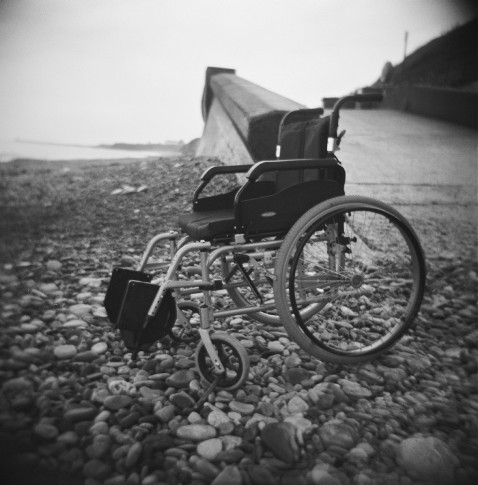
There is a craggy shore jutting around the beach. Just off  the edge of a sloping ramp, he parked over tumbled ocean rocks. My father sits in his wheelchair facing the sea. He always loved the sea. He turns and smiles at me. I stand in front of him, holding my arms out to him for leverage, but he waves me away. He stands and walks, navigating the rocks. He can walk. I can't believe it. He is healed. At night, I dream that my father can walk and that my daughter is alive. They are impossible dreams. Dreams borne of half-awake prayers that start as grounding but end in cures and resurrections and healing. He walks past me toward the wild sea, all white caps and the thunderous booms of water falling to earth. He stands before the ocean, glancing back at me before walking into the water, fully clothed, but free.


photo by RachelCreative.


I’m not sure if my father remembers that my second daughter died in my belly. But whenever I talk about how my baby died, my father cries. His sickness envelopes his body, wrenching his hand into a limp, unusable limb, seating him forever in a wheelchair. It took decades of slow torture, losing his abilities one at a time. His legs shake involuntarily like phantom remembrances of walking.

His emotions run closer to the surface now. He expresses, emotes, leaks tears despite himself. I hadn't seen my father cry until I was in my twenties, long after he was diagnosed with Multiple Sclerosis, then it seemed his crying wouldn't stop. I used to avoid making him cry. I turned away from him. It embarrassed me. I cracked a joke. But these days, it comforts me to see his humanity. It reminds me that this man is my father and I am his safe space, even though the crying is so unlike him.

He doesn't remember her name, or at least, he has never spoken her name aloud. He never has spoken of her. He has never asked me about the grief. He has never asked me how I am coping. He asks me how my new house is, even though I have been here for five years. But when I mention Lucy, he weeps. It is like he suddenly remembers. Or perhaps it is as though he is hearing it for the first time all over again. It is so sad that our baby died. He forgets, but when he hears about it, he knows it is sad.

The day after I returned from the hospital, after birthing my stillborn daughter, I called my father. I wanted him to hear my voice, to know that I was okay. I was obliterated, destroyed, yes, but I was alive and talking. When I told him the baby died, he cried. We cried together on the phone. A few minutes later, he asked me when I was coming to see him. He wanted to know when I was bringing his laundry to him.

I hung up and wept into my hands.

Birth, dead child, hemorrhoids, unused engorged breasts, no flowers, no funeral. My father still needed his clean clothes. He still needed his clothes. I didn't even begrudge him that. Even in our worst moments, we still need food, water, air, clothes. I just couldn't give him any of those things in those first weeks, particularly not clean clothes. I wept not because I was hurt, but I wept because I miss my father. I miss his health, his paternal advice. I miss all that he could have said to comfort me.

Resentment for the friends and acquaintances who said nothing was a wild, suffocating vine winding around my heart, squeezing out my compassion, clinging to my fear, bearing a bitter, inedible melon. Yet I have a vast well of patience and acceptance of my father. I suppose it is easy to have compassion for someone who is sick. To be forgiving and loving and compassionate to someone whose disease robs him of his memory, paternal instincts, and empathy. I sit cross-legged and send him compassion every day, even though twenty years ago, I wanted nothing like compassion for him. I wanted my anger. I liked my anger. But it softened after a few years, and transformed into a patient, unconditional love. That is what he gives me, unconditional love, given and received.

Last week, I heard a speaker talking about spiritual suffering. He asked the group, "If you are standing in line in a convenience store and a boy in a wheelchair cuts in front of us, would you lose your temper? Would you have words? Would you ask him to step outside? Or would you graciously give him a moment, gesture for him to take your place?" He remarked that most of us would be forgiving, compassionate, generous to the boy in the wheelchair. We all nodded. Then he asked why we don't treat everyone else in the world with the same compassion. What if you could see everyone as a spiritually sick? All the people who stepped in front of me in line, or cut me off in traffic, or berated me for one thing or another. Or those who couldn't manage a simple "I'm sorry" after the death of my daughter. What if I could see those people as spiritually helpless? Spiritually sick? Emotionally handicapped? What if I could treat everyone else as I treat my father?

After three years, I am only now getting to the point where my anger and unrelenting expectations of other's capability has softened. So much of my emotional forgiveness was spent on my father some days, I thought it sapped my reserve, as though tolerance and compassion were finite resources, quantifiable and conditioned. I wrapped myself in intolerance for people I deemed well enough to know better. Righteous indignation was my woobie, my excuse for not allowing people into my grief, to bear witness to my vulnerability, my weakness, my need for friendship and compassion.

I understand now that my father's gift to me after Lucia's death was needing me. He needed me to do his laundry. To get up and have someone to be accountable to, someone who was able to cry about how sad it was that my daughter died, but who still needed me to get up. He didn't see me as weak, absent, lacking, intolerant. He saw me as his strong, able daughter, bearing the brunt of daughter-death and father-caring. Or maybe he didn't remember her death, but perhaps that was a gift too.


Do you have different standards for support from your friends than your family? Do you expect more from your friends or family? Do you have anyone in your life who receives your patience and forgiveness despite their approach to your child(ren)'s death? What makes them different than others? 

Despite Silence

I cannot stop missing Silas
despite everything. 

Despite time broken into before and after.
Despite new life in our lives.
Despite a distance beyond comprehension.
Despite the black, despicable wall of death.  

I feel his absence in my brothers and parents.  

I see them not seeing him
where I don't see him either.  

To this very moment years from his grave,
I cannot believe this is part of us:
that my parents have a life where their grandson died.  

Awful.  Outlandish.  Ridiculous to the point of unbearable pain.

How brutal this world,
where this is something that can happen in life,
where Death takes children and shatters lives to pieces.

That mocking Sun that goes on shining.
The blithe lives that go on living
while our little one is gone.  

All of us in my family feel it together
and that shared grief eases the burden enough
to make another day doable,
with Silas only in our hearts.

I find that sometimes it is easier to access and understand these brutal emotions via poetry.  To that end, I invite you to write a poem about your lost child or children and the living family around you.