Pale Blue Dot

See the faint dot between the white lines? That's planet earth. And it makes me wonder about my dead baby.

Just before Voyager 1 ended it's primary mission and blasted off towards the outer reaches of the Solar System, it spun around and snapped a photo of earth, some three and a half billion miles away. This photo was taken in 1990 (and the Voyager, incredulously, is still going).


On the one hand, of course, the sheer insignificance of the earth, and our lives, in the grand scheme of the solar system is sobering. There appears to be a bigger story being written, cosmic and infinite in size, and one that will be downright impossible to ever understand. The notion that any of us, with such finite minds and limited understanding, could have anything figured out seems almost foolish. As astronomer Carl Sagan pointed out, “Our posturings, our imagined self-importance, the delusion that we have some privileged position in the universe, are challenged by this point of pale light. Our planet is a lonely speck in the great enveloping cosmic dark.”

From this vantage point of earth, everything about our significance is lost. The pain and joy and suffering and pleasures of our earthly human existence are all invisible. From out here looking in, our spinning earth boils down to life and death. The collective species lives and dies and enters the earth. End of story.

Insert my Margot into this picture of earth and you can barely discern any difference between her and the rest of the species. She lived, she died. She suffered the same fate as everyone else, and from this far away, the difference between her life and her great, great grandmother’s life is a mere blip in time, the same beginning, the same end. There is no tragedy from this vantage point, no suffering, no feeling of loss.

I am insignificant. She is insignificant. But at least we are together, tiny specks on a tiny speck with no Horton looking out for us. And there is some peace in this reality, some science comfort.

The other side of this image, however, reveals what a crazy, far-fetched, inconceivable fucking miracle it is that we even exist at all. The notion that the universe aligned in just the precise way for the species to make their grand entrance on planet earth, and for the species to continue to evolve over the millennia, and to evolve in such a way that our brains allow us the ability to think and feel and experience this little speck on which we live, is damn well breathtaking.

It’s here where I feel the tragedy of Margot June more deeply than ever. Her own miraculous story was cut short, without ever getting to experience this cosmic mystery of life on earth.  

I used to feel so sorry for my family, for our collective broken hearts, for the life we didn’t ask for, for the loneliness of losing a child. For her mother, whose waisted milk came in and dripped aimlessly down her flesh, who carried her for thirty-nine long weeks, who felt this more than anyone; for her sister, who kissed her in utero and spoke of her constantly, who always got this euphoric look in her eye when we described what being a sister meant for her; for myself and the broken dream of raising two girls, holding them both in my arms as we navigated life together.

Now days I mostly just feel sorry for her.


For in this image, I’m reminded of the revelation that she was, and all that was waiting for her on the other side of the womb. I’m heartbroken she missed out on the complexities of life on earth, no matter how insignificant or miraculous our pale blue dot is.


How does this image of planet earth make you feel in regards to your missing children? Does it bring peace or despair or a mix of both? Does science play a role in your grief? As the time has dragged on without your children, have you felt more or less sorry for yourselves?

Wild Nights

The Irish, I am told, are fond of sex during wakes. This is very likely one of those gross cultural abstractions, one that bears no resemblance to the real world.

And yet, in those early days, I understood the terrible and fierce appeal of celebrating life and love in the midst of death. I understood carnality.

I wanted my husband in a way that I had never wanted him before Gabriel’s death. I wanted him because I wanted to shake my fist at death. I wanted to proclaim the wonder of life and lust and joy in the midst of such sorrow.  I wanted to get back to what I only enjoyed for a brief period.

I don’t think I have ever told him this.

I was ripe, verdant when I was pregnant. After years of trying to not get pregnant – living life a bit shriveled up, convinced I would be the teenager, the young woman who ruined her life getting pregnant. (If only I had known.) I lived with the baggage of a Christian background, guilt and miasma heaped on me. It isn’t that I never enjoyed sex, but I never fully let go. I may have been married for 7 years, supposedly able to copulate guilt free, but there was no revelry.

At the end of my first trimester, and in a way I had never understood in all my 29 years, I just relaxed. I enjoyed, luxuriated. I loved sex. It was spectacular. My body had finally performed as warranted, and it was my time to revel in this. I told you I felt verdant – but it was more than that. I was full, round, fruit ripened in sunshine.  I was soft and lush - fecund.  I felt not just sexy, but sensual. I loved that word then and I still almost hate it now.

Would it shock you to know I was angry I lost this after Gabriel died? I wasn’t verdant after all. There was no ripeness in me.

I wondered, worried, fretted, freaked - was I forever destined to yearn and dream for that feeling of fullness again – all of that roundness and all of that ripeness – would I never taste it on my lips again, feel my body laid back and splayed out in glory? Maybe 24 weeks, well, 12 weeks of good sex maybe that was it.  And if that was it, if 3 months had been paradise and I was in paradise lost, why on all of this green earth hadn’t we had sex every day? Why hadn’t I rolled around, found satiation every chance I got?

I haven’t really looked back like this – applied the careful thought to sex that I do to grief. I have found the experience remarkable. I have found that the words, the images and the adjectives that spring to mind to be surprising.


Continuing the discussion from Jess’ post, as yourself or as anonymous. Use words or images or snippets of poetry. Do you regret? Yearn? Wish? Is there loss in this as well?

One blushing shame, another white despair

We are in a cafe. I blush and stutter. I look through my eyelashes at our neighbours, laughing into their lattes. I murmur, fearing their ears.

We are at my house. I breathe in and unseal my lips in a tiny gesture of anticipation. We are friends, confidantes. You are unshockable in the presence of my grief and rage. But now I am aware of the couch we sit on, the bedrooms above us.

So perhaps it is better that we are in neither of those places. You are there. I am here. This is silent noise. You can adjust your features so that they appear neutral, impenetrable. No one need know that this is what you’re reading. Unless you blush too.

Because here is the thing, the topic, the theme, the issue, the matter at hand. Here is the subject of this post. It’s... it’s... it’s... sex after loss and there is no pretty or dainty or literary way to say it other than that:

Sex after loss.

And what a complicated and difficult subject to address. In grief you yearn. You yearn for a little body, a milky mouth, a tiny foot in the palm of your hand. Is there room for that other yearn, that other want? To need, to desire: they have different meanings now. And now sex becomes about another baby, or not another baby; about bodies that don’t do what they’re supposed to. Bodies mean pain, or sick, or tired. Bodies are small and covered in wires. Bodies are still and cold. Bodies are not the colour of your lover’s skin, but mottled and blue.

Some people are drawn together and some are wrenched apart.

We were wrenched apart, but still we came together. We wanted our baby and so we were naked in our nakedness. And so another baby came. But that is not a given for our kind. There is no guarantee of fertility or of the end result. The end result: the one that seemed so certain to me all those years ago as I stomped up the stairs of the sexual health clinic in second hand army boots, for condoms and pills and other armour.

We are all different. You might believe that my kind of sex neither takes its appropriate form nor serves its appropriate function. You might have stomped up stairs for the same reason I did, or you might find that abominable. You might have loved it, or not. You might have shared it with many people, or with one. It’s political, it’s personal, it’s universal, it’s fucking everywhere. There’s fucking everywhere. In the same way that in those early weeks after Iris died every woman was pregnant, every commercial was for baby paraphernalia, every goddam Facebook status update came with a fuzzy ultrasound photo. Everywhere, everywhere, everywhere, until sex WAS loss and its expression evidence of the distance between us.

I pause and exhale. My hands push in to my eye sockets. I wish we were in that cafe, or at my house, or better still at a bar with an infinite  line of tequila shots and a cute bartender, and I would shout ‘SEX!’ too loudly, and everyone else would blush,  and we would cackle instead of cry.

But instead you are there, and I am here, and now I have to ask: how was it for you?

Has sex changed for you in your grief? Why? How? In what way? Be frank, be euphemistic, be anonymous, be however you want to be, but please tell me.

questions and answers

photo by wakingphotolife.


What is Lucy made of, Mama?


She is made of people ash with bone.

She is white, almost. Sometimes grey.

She had no knuckles, she was too young, I think. So there are no knuckles bones. So she is the other bones with people ash. That is what her body is made of, daughter.

But the important part of her is made of whispers and prayers and paint fumes on a spring morning, a candle lit to push away the stink of it, and a moment we took advantage of. The wind blows the chimes in the dining room.

She is made of chimes.

She is made of sprouts and nests and small mites writhing in hay. There is a chipmunk who sits on the roof of the garage. I wave to him every morning. She is made out of him.

She is made of wood blocks and printing ink. She is made of porcelain and  papier-mâché. She is made of vine charcoal and 90lb. paper, shredded and waterlogged with seeds embedded in its pulp. She is made of summer and fiddleheads. Yoga and smoothies with berries and almond butter. She is made of long flowing skirts, and a purple dress that made me look like Barney, but feel like a goddess.

She is made of email fights and heartbreak and broken clavicles, too. I try not to talk about that part of her, because I used to believe that the dark parts of her making killed her. Sometimes I think that is what made her live so long. It gave her tenacity. She is made of strength.

She is made of the moon. Further, she is the moon. Hanging effortlessly over our nights, disappearing gradually day by day, and then appearing again, brighter and closer than ever. She is also made of winter solstice. She is made of icicles and darkness and sad songs about sunshine and being taken away

She is made of atoms and stardust and self-sacrifice. She is made of nothing, but everything.


How old is Lucy now, Mama?


She is as old as the trees, my love. Her roots are so far into the earth, they are lava and rock. She is the Anasazi. She is the crone. She is the baby whose bough is breaking. She is as old as the canyons and young as the idea. She is a moss-covered age, one with ferns at her base. She is sixteen and driving erratically. She is eighty and hunched over in secret lives never lived.

She is three and two months old. Younger than you, but also ancient, like the gods, and at the same time, she is always newborn.


What happens when we die, Mama?


Our skin grows cold and turns ashen. Our body becomes stiff. The skin around the fingernails recede making every fingernail longer. The skin hides away and reveals something animal about our humanity. The meaning of life is gone then. The carnal meaning, I mean. The impulse for more is gone. We are just skin and bone. We are carbon, filtering into earth. It nourishes something lovely, we like to think. That also is transitory. The spark leaves our eyes and enters other people's hearts and burns brightly. So brightly it feels like fear. I want to tell you that our body is a shell, as cumbersome and heavy as a turtle. We figured out how to carry it, but it is not comfortable. The part that rots and makes a home for other creatures of the dark, that part is not us. It is something else. It is soil. It is life in its death. We do not have a soul, baby. We are a soul and have a body. I read that once. I believe that.

But what happens to our soul, baby, is not my privilege to know. I just sense that we become part of every person and everything, like a raindrop falling into the ocean. Can we separate the raindrop again? Never, but we still are water.

What do you think happens when we die, baby?


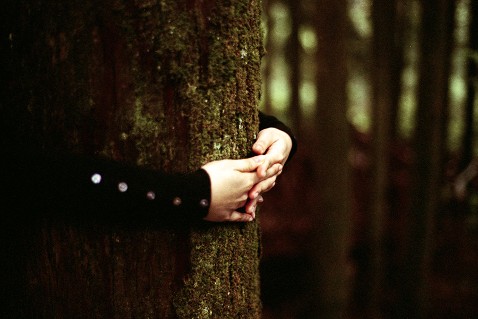
I think we go into trees, Mama. That is why it is very important to hug trees.


+++


What round about answers are you giving these days? What kind of questions do you get asked, either by children or adults, that stump you? How do you answer them? What kind of questions do you ask? Are your answers concrete or esoteric? Have your answers changed over time?

or alternatively, you can just tell me what your child is made of...

Silas' Symbols

The hawk is stationary above the highway.  The mundane light post is transformed into a majestic perch with the beaked, mottled, patient bird gripping the metal with its talons.  It is looking for prey, but it feels like it was waiting for us.

We always point them out to one another on our drives, and not a word has to be spoken.  Silas, we both think.  Silas there somehow in the penetrating gaze of the bird, even though we don't really believe that, not in any direct, concrete way.  It's not his reborn spirit in there.  It's not his soul transformed into a hawk.  

Instead, it is a living, breathing symbol that we can hang our grief on.  Silent, alien, unknowable, beautiful and free, the creature is a perfect specimen of raw nature and it represents so much of what we don't have from Silas, and so much of what we wanted him to be.

Three hawks today.  Yesterday I saw one plummet from the sky to the median between the north and soundbound lanes and then leap into the sky with some squirming fur in its grasp.  The hawks are reminders of his life in a safe and abstracted way.  

After all, it is hard to remember someone you never got to know.  

We remember him as an absence, as a lack, and the hawk serves as a placeholder for everything we still don't understand about why Silas is not here with us today.

At night when the hawks sleep Orion captures my vision instead.  Pinpricks of light billions of lightyears away arranged just so, and they pierce me with their interstellar light every time. We chose that name for him, selected that specific connection, and it ensures that every single night that our planet faces that part of the sky I see him and think of him and hold him close in my heart.

Closer yet, though, is the ink in my arm.  It is a tree of life darkened with death and sprinkled with the stars of his constellation, surrounded by a ring of "S"s.  And it's funny/not-funny how much an "S" looks like a broken infinity symbol.  

Silas is gone forever, but I still find him every day in pieces of my life.  In the hawk above, in the blazing stars of the Universe beyond, in the very fabric of my skin.  I will never stop missing him, even when happy, even when feeling good and right.  

His name is engraved on the inside of our wedding rings, just like it is etched on the deepest walls of our hearts.  The symbols help us remember him as we hoped he would be, but the pain ensures we will never forget the child we do not get to hold in our arms.

What are the symbols you connect to your lost child or children?  Did you create the connection or did some outside force cause you to recognize it?  Do those symbols and reminders bring you peace or pain? Have the symbols changed over time?

open letter

In late July, an email came into the contact form in the Glow in the Woods email inbox. I respond to those requests when we get them. It was from a woman who hadn't lost a child, but whose best friend had. She thanked Glow in the Woods for giving her a starting point in the piece How to Help a Friend through Babyloss—a section where we hope to guide friends in the right direction. (We urge you to add your own experiences with what was and wasn't helpful in the comment section of that post.) She asked if we knew any blogs for the friends of babylost parents, or if we could direct her for support. I suggested she post the question in the forum, and I posted the question on my social media sites. But the depth of compassion and love for her friend was so palpable. Conversely, the compassion and love this community showed her strengthened my conviction that conversations about friendships and child-death need to continue happening. 
She wrote again in December, thanking this community again, telling me where she and her friend found themselves now  in their grief and their lives. I found her insights so valuable, I asked her to consider writing a guest post for Glow. In the earliest months of Glow in the Woods, Julia's friend Aite shared her thoughts on abiding. Today, I am honored to share Rachael's open letter to Glow in the Woods. —Angie

Dear Glow in the Woods,

You don’t know me, but I feel as if I know you.  I have been a visitor, each and every day for the past seven months.  I have read your stories—every word.  I have followed those stories to your blogs to your spoken word videos.  I am a lurker, because I don’t exactly belong.  I am on the outskirts of this club, the one that you never wanted to join.  I don’t know yet if I am the only one.

I am here because seven months ago, my best friend gave birth to a beautiful, full-term baby girl who had mysteriously slipped away from life a few days before she was born.   

We had spent the weekend together, my friend and I.  I had invited her to spend a few days with me and I relished every moment of it.  We ate wonderful food, took dozens of pregnancy photos, listened to music, and reminisced.  We floated for nearly two hours in an outdoor pool and I cackled uproariously at the sight of her schlepping her pregnant body into an inner tube.  We sat in the warm July sunshine and excitedly discussed her impending motherhood.   It is hard to believe how quickly life can turn its back on you, how fast everything can change, how tragedy strikes in the blink of an eye.

The doctor said that the baby died sometime during that weekend.  I have drug myself to hell and back since the moment I heard the midwife say, tentatively, “Saturday, maybe.”  Why didn’t I ask her if the baby had been moving?  Why didn’t I put my hand to her belly, as I had done before?  Well, because I was having fun.  Because it wasn’t the last thing on my mind, it was something that had never been on my mind.  Because in the world I used to live in, babies didn’t die.  Oh, maybe in third world countries, or in cases of extreme prematurity, or later, to SIDS or something else, but not here, and not to my healthy, well-deserving friend and without any warning whatsoever.   

Like many of you, I have desperately wished for the impossible—the chance to rewind time.  I’m not asking to go back and retake a Biology exam that I wasn’t well prepared for.  I’m not asking to go back to my teenage years, when I made all of the wrong choices.  I’m asking to go back and try to save a life.  And not just any life—the life of a child.  This should be possible.  My dreams try to convince me that it is.  They play like a movie reel, where I am transported back to that weekend and I say, nonchalantly, “Hey, let’s go to the hospital and make sure everything is okay.”  Or maybe even further back than that.  To the day we spoke on the telephone and my friend told me that the baby had been quieter than usual.  To when I said, “Babies do that when they’re getting ready to be born.  It’s the calm before the storm!”  I laughed when I said it.  It was funny then.  It’s not funny now.  Not funny at all.  Allowing myself to go back and think of that conversation immediately brings forth a feeling of guilt that is so ferocious I can feel it stinging my throat, like bile.  It forces me to examine every moment of that weekend, to ask myself if anything I could have done or said would have produced a different outcome.  My mind refuses to stop multiplying and examining an infinite amount of scenarios.

And then, there was the morning that she called me, just twelve hours after I had dropped her off from our weekend together.  She was having contractions, but I didn’t believe it could be active labor just yet, and I was slow to get ready and drop off my children with my mother.  She arrived at the birth center and an examination revealed that she was seven centimeters dilated.  I did not make it to the birth center in time for her to hear the horrific news that there was no heartbeat.  She was completely alone.  The midwife had another laboring woman at the birth center, with no backup or assistance of any kind.  So as a result, my precious, heartbroken friend was left to labor through transition with the knowledge that her baby had died.  And she was all alone. 

Meanwhile, I was driving like a bat out of hell, selfishly hoping that her labor had slowed down just long enough to allow me to witness the birth.  A bright, sunny morning had transformed itself and as I drove, the clouds were darkening.  Sparse droplets of rain became a torrential downpour, the entire sky opening up to warn me of what was to come.  I didn’t see it then, refused to acknowledge that it could have been an omen.  And so, I arrived at the birth center, stupidly full of giddy excitement.  What transpired in the following hours all crowd together into one big, jumbled smorgasbord of shock, anger, fear, guilt guilt guilt, adrenaline, trauma, disbelief, empathy that became physically painful and so, so much sadness. 

The next morning I had to force myself to say goodbye, to my friend, and to the baby that she still held in her arms.  I was expected to resume life as normal, to come home to my four rambunctious boys and my schoolwork.  It didn’t happen to me, after all.  I could see it in the eyes of those who tried to comfort me.  They said, “Just be grateful for the children that you have,” which is a condolence that not only assumed I was ungrateful to begin with, but tried to diminish the grief and loss I felt for a child that I wanted and expected to be a part of my life.  I tried to sit with the boys and be present and shower them with love, but my mind was somewhere else, and their needs were too great.  Life itself felt surreal, a thick fog lining the edges as I walked aimlessly through the supermarket, lost.  I was consumed by grief, and by an insatiable need to fiercely protect and care for no one else but my friend.  It was here, on Glow, that I found solace, and how I discovered that my own words could bring healing as I filled up pages, previously blank. 

So now you know.  I am here.  Not with my own story, but as a keeper of someone else’s.  A story I cannot forget-- one that, at first, tried to destroy me.  A story that still begs to be heard, that unfolds each day and continues to reveal so much—about loss, about grief, about the power of friendship, and about healing.   And it is through your stories that I have learned how to be present for my friend, how to begin to understand just a sliver of her experience, how to nod at my own guilt and then let it slide on past, and how to allow myself to remember and love a little girl lost, one rainy day in July.

—Rachael

If you are here, feeling like a lurker, consider this post an invitation to introduce yourself. Whose story are you keeping? And for the babylost, how does it feel to read of the grief of a friend? Do you have a friend who keeps your baby's story? Someone who bears witness? How does that relationship feel? Has your child(ren)'s death brought you closer or pushed you away?