Of Birds and Bees

We all bring a set of issues to the table of grief, whether it be a side-dish of marital problems, a salad of anxiety, or an appetizer laced with previous tragedies which this seems to compound. There's the bottle of money woes, the dash of low-esteem, and perhaps even (hidden under the napkin) the telltale odor of previous bouts with depression. All of these shade and color our experience, and shift our individual abilities to cope with babyloss. I'm not here to rate which are at least edible, and which could stand to be thrown into the compost, but I am going to discuss one particular problem many bring to the table and set down with a thunk, with the grace of an overcooked, 25 pound stuffed turkey.

That would be infertility.

Babyloss after -- during -- infertility is it's own peculiar injustice. For starts, infertility in and of itself can create it's own side excursions into mental trauma. As one avid reader here said to me in person recently, infertility is its own kind of grief.  For starts, what comes naturally in the pickle commercials and to your friends who seem to just look at each other naked and procreate, for you is not meant to be.  Frankly, that alone deserves some mourning.  There's the monthly reminder of failure, which you try hard not to internalize, but it's hard to go through more than a year without getting a bit mopey about overall body image and capabilities. Add to this the strain on marriage, which you try and avoid by making sex fun! And unto itself! But seriously, you're both eyeballing the calendar and know and wonder when it will be fun again, and secretly debate who exactly is letting whom down. Meanwhile all of your friends are pregnant and having babies and wondering what in hell you're waiting for? Time's a ticking! You go to your thousandth baby shower with a stiff upper lip and cry on the way home.

You finally go to an RE (that's Reproductive Endocrinologist) who runs you through a pantheon of testing. If you're lucky, you've climbed online and read up on this stuff so you're prepared for the discomfort of mulitple blood draws on various days of the month, watching radioactive dye run through your fallopian tubes, or having your uterus filled with liquid and monitored via ultrasound, or an uncomfortable uterine biopsy. There's the indignity of going in on day two of your menstrual cycle for a vaginal ultrasound to check the status of your ovaries, and the ever-popular post-coital testing where you run into the office when you should be lounging naked with a glass of something and a cig, and have them take a sample of everything that you didn't leave on the mattress to see if sperm can indeed make it through the secretions that you produce. And don't get me started on the discussion with your husband, which starts with "Honey, I really want to have a baby" and ends with "And so you need to go into the office where they'll hand you a jar. If you're lucky, this office may even have some inspirational magazines for you as well."

And that's just to get a diagnosis. If there is one to be found. Like so many things medical, after all of this, the answer is often "unknown."

Because now we know, maybe, or at least have an idea, there might be surgery to rid of endometriosis or fibroids or a blocked tube. Or IUI (Intra-Uterine Insemination -- you know, the old fashioned way, except with a turkey baster). Or if your husband presents a problem in the equation, IVF with ICSI (Intracytoplasmic Sperm Injection. Say that 10 times fast). Drugs are dispensed, often to yourself with syringes and detailed instructions on what needs done intramuscularly. Sometimes you skip right to IVF (In Vitro Fertilization), and sometimes there's a mind-blowing discussion about dead or absent sperm or a lack of eggs or a misshapen uterus that ends with the RE telling you about gamete donors and/or surrogates. Sometimes there's the unexpected surprise that all of these miscarriages you've been having are caused by a genetic problem carried by you or your spouse. Sometimes there's simply a vial of pills, sometimes there's the fluke of luck while waiting for the next round of shots to start, and sometimes there's the hellish conclusion that this will not end the way you intended when you walked in.

I should pause here and remind people who are staring at this jumble of acronyms and procedures like hieroglyphics that much of this testing and prodding and medicating and inseminating is not covered by insurance. Unless you're lucky enough to live in a small handful of states (or countries) that have rightly deemed infertility a medical problem necessitating treatment and hence coverage (and you're lucky to have insurance to begin with!), you're paying for this out of pocket. According to Resolve, the average IUI runs $865, depending on the medication needed; IVF's average (that's average) $8,150K, NOT including medication (which runs, on average, an additional $3,000-5,000). (For the record, I just used some banal progesterone, apparently necessary to keep embryos attached to my uterus but not covered by my insurance. The cost per 4 weeks of a daily single dose was $800, and I needed 8 weeks. And I consider myself lucky that's all I needed this time around.)

I know people who took out second mortgages for ART (Assisted Reproductive Technology), and people who used inheritances, and people who drew out of their retirement accounts and/or borrowed from family. All to achieve what many can do after turning off the late night news and climbing under the covers.

But let's say you get lucky, and get pregnant.

Worth it, right?

And now let's say your baby dies.

:::

Back up for a moment to what this reader said to me: Infertility is it's own kind of grief. It's a monthly dash of hopes, a monthly reminder of promises gone down the drain, often with the checking account. It's the thought when an embryo is tucked safely inside you that this is it! This is life! This is our life.  This blob will be my child! Only to be greeted by one line and blinding white two weeks later. Multiply this over, and over again. Possibly for years. Possibly having set your limit -- your emotional and financial finish line on the next attempt: this one is the last one. This one works, or we grieve never having children of our own, and move on to something else. Hope and faith and trust and marital communication may have left the building long before the death of a baby. You may have been desperate, on that last attempt, bargaining, wondering if anything would work.

In that regard, the death of a baby is part of this winding vine already invading your life. It's another loss, another dash of hopes, but this time on a much larger scale because . . . well obviously, it's different to hold a dead child than to stare at a negative pregnancy test, but there's also the thought that That might have been it.

Because you can't simply wake up one morning and say, Let's try again. As hard as that discussion is to have another baby after the death of the last, if you're infertile it's more complicated. There isn't the subconscious knowledge that Well of course this will work again like it's supposed to.  You need to pick up the phone and explain to people what happened, and what you'd like to do next. You need to go through a lot of the rigamrole again. You may need to alter how many embryos you transfer, or depending on why your child died, move to gamete donation or surrogacy. Perhaps you need to now fork out for PGD (Pre Implantation Genetic Diagnosis) (Incidentally, another average of $3,500 on top of your IVF expenses) to make sure any genetic problems aren't being passed along. You need to set to set a new limit, a new finish line, and further deplete your bank account. And each month that passes with an HCG (Human Chorionic Gonadtropin) test of two or less, you sink further into a bleak place. Perhaps that child was it. The only time this would work.

And sometimes, that is it. There are people here in this community, who read here, who reached the end. The end of the line. The money tree dried up, their emotions were frayed after years of trying and failure, and they needed to stop and move on. Move on with another life than the one they originally envisioned when they simply set out to have a baby of their own making. And that, putting behind not only a dead child but the attempt to have another of your own, is it's own crucible of grief. Inextricably wound up with the death of a baby that we're all familiar with, but branching out and encircling so many other parts of your conscious and marriage and identity and being. And like any loss, this deserves its own moment of grief, too.

Did you seek Infertility treatments in order to get pregnant with your child(ren)? Are you having to with a subsequent child? For you, how does your babyloss fit in with infertility -- does it stand alone, or has it become a chapter or branch within a greater struggle? Do you have limits? Have you met them already? 

Winter. Discontent.

I must admit-- it snuck up on me. Suddenly, it's dark by five and it's snowed twice since Sunday. Fall around here was a blur of pass the flu, and have you seen my deadline, but good things too, like sneaking away for a retreat or taking a short family vacation over Thanksgiving. And somehow in the midst of all the crazy, or maybe because of
it,
I managed to not let myself dwell on the the impending change of seasons, to chase away any stray thought of it that snuck in univited.

Winter, which I used to love without reservation and which still contains many things I love, is now my grief season. A's anniversary isn't until the very end of January, but for the third year now, I begin to feel its approach with the change of seasons. I am thinner this time of year, more transparent. The wind blows straight through me, or maybe through a hole in me-- I can't tell. It whistles the tune of longing, of missing, of love. 


Anniversaries abound in the bereavement blogosphere these days. But for those whose actual days come in a different season, and  for those whose losses are too recent still for any -versaries, there are the holidays to contend with. Ubiqutous decorations, ever-present lights, mandatory good cheer. Cards in the mail, commercials on TV.


So I just wanted to stop for a bit and ask-- how are you? How is the season treating you? How are you taking care of yourself these days?

Come, sit a minute. Have some tea. Have some wine. Have a good cry. Tell us how you are.  


on survival

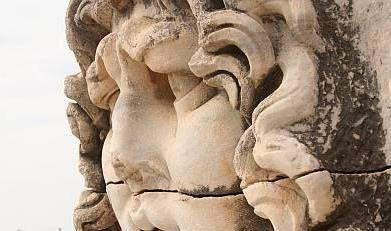
In Greek mythology, Medusa is a "guardian, or protectress". She is viewed throughout history as equally beautiful and terrifying.

I wonder how many of us here can relate.

On holiday in July we drove for hours through rolling Turkish hills to visit the ruins at Didyma.  Typically, I need to be in the right mood for these types of things. I was on the fence until my Lonely Planet guide told me to “be sure not to miss the sculpture of Medusa that has remained surprisingly intact among the rest of the ruins”. Or something to that effect.

Sold.

I remember that the heat that day was the kind that gives everything in sight a shimmering, rippled effect. We walked slowly through the remains of the interior, then circled the perimeter.  I felt like a grain of sand on the worlds longest beach - dwarfed by the enormity of it all.  I finally found the medusa set away from the rest of the rubble. I had walked right past her on arrival.

Temple of Apollo, 2nd century A.D. Didyma, Turkey

She sits with pride of place at the entrance, cordoned off and stoic despite the deep crevices that mark her face like scars. More intact than any other scuplture in the ruins.

Look at you. Barely a scratch compared to the rest of them.

I pulled out my camera and smiled, remembering finding this for the first time in the middle of a sleepless night in the month after Sadie died.

Of course you’re here. What better vantage point could you have?

Commanding.

Serene guardian.

Mother hen.

Survivor.

Terrifying when provoked?

I can definitely relate.

.::.

I open my work email first thing to see the subject line, “VISIT TO X CHILDREN’S HOSPITAL”. The air is sucked out of me as I read a lengthy note to all staff about plans for Father Christmas arriving on a Harley, playing on our weaknesses to plea for gifts and funds.

"The children in this hospital are often seriously ill and many will be hospitalised over the festive period. A visit was made to the hospital last week and it was stated that many of these children will be hospitalised over the festive period, some indefinitely."

Memories I’ve had parked in a far away corner wave over my brain like a monsoon and I can’t not cry. I spend twenty minutes in the bathroom regaining my composure.

.::.

I’ve often wondered what it takes for a person to survive something like this. What fabric makes up the kind of soul who can stare down the deepest and darkest tunnel of despair and turn up alive at the other end? Hardly unscathed, but alive nonetheless. None of us are superheroes as far as I’m aware. Just your average Joes and Janes, as random as it comes, without a (traditional) superpower or weapon of choice in sight. Yet here we stand, called on to perform an astonishing, awe-inspiring feat.

This thing called surviving. We do it. We are all doing it, right this second.

We do it with therapy. We do it with screaming and booze and prescriptions and sex.  We do it with the help of partners who are the one person on this entire godforsaken planet who understand us, because their loss is tied forever to our own. And we do it for our living children, or our desire for future children.

And then there’s time, survival’s wingman if there ever was one. 

.::.

“You know you don’t have to feel bad about talking about it.  I think you’re so brave, Jen.”

I do it because in spite of everything, I am still a hopeful person.

.::.

Survival means different things to all of us. What is it to you? What’s your superpower?

gratitude

It’s gut wrenching how much I long for her these days.

A whirl of small brown leaves flies against the windshield of my car as I drive by their tree, almost bare.

Hello, Beautiful…

I feel her close, I really do.

And also, deep in my gut, everywhere in my heart, in all of me – the awareness that my child in her body is missing.

For about a month, we’ve had her picture close by in the dining room of our new home. It’s in a temporary frame… I’m working on something much more grand, much more beautiful. But her sweetest face is there in all its 8x10 glory, peeking out at us as we eat, draw, do homework, putz around on the computer, talk. As I write this.

There she is… and yet that’s not her. It’s just her photograph. Sometimes I feel her there. Sometimes she is in the leaves. Sometimes in the occasional milkweed seed that reminds me of the oh-so-sad-so-terribly-incredibly-painfully-sad week we spent in the mountains after we said goodbye to her. Sometimes in the red tail hawk that flies above Cincinnati, though much less frequently than she did in San Francisco.

When I look at that photograph, I just miss my Baby Girl… in the flesh.

I am reminded each time I look at it just how beautiful she was. And how much she struggled with each breath. That’s when the tears come, when I remember those days in between,

She’s doing surprisingly well… this is what she’ll need in order to come home,

and,

She just can’t get enough air into her small fragile lungs, even with all this support.

That’s when I imagine what it would be like now if things hadn’t turned, if she had come home on oxygen and continued to get stronger.

*****

I know how lucky I am that I got to know her when she was alive. I know how lucky I am that I got to hold her, to kiss her, to sing to her, to touch her soft skin, to look into her eyes as she looked into mine. I know we didn’t all get that in this community of deadbabyparents… I wish we all had. I wish all of our babies were still here, in the flesh, alive and well.

Maybe I have more photos of my baby, but it doesn’t make it easier to have lost her. Nothing can make it easy to lose a child. Easy isn’t a word I identify with anymore. As a word, it feels trivial and doesn’t serve me much. But hard… that feels too simplistic. Sometimes it isn’t hard. Sometimes it just is.

Strange feels more like it these days. Strange because I can simultaneously feel acceptance and disbelief. So many days that is my normal. I still say to Tikva, several times a week, silently or out loud,

Oh Baby Girl… you died. You died.

Then a voice within me will remember, will insist,

But you lived, too. I won’t ever forget that you lived. And for that, I am grateful.

It may have been a blink of an eye, like a daydream… but I wouldn’t trade it in for forgetting the loss of you. Not ever.

*****

I was terrified last year at this time to spend Thanksgiving with our family. I was terrified to be up close and personal with Tikva’s cousin, who was born during the weeks in between my daugther’s birth and her death. I was so scared of being face to face with the reminder that my baby wasn’t there, that he was here and she was not. The fear became something bigger than itself, and I almost spent Thanksgiving separate from my entire family.

But in the end I went. And I sat with this beautiful little boy on my lap, felt his newness, looked into his big brown eyes that reminded me of Tikva’s. And I saw his bright soul, felt his pureness. The ease of being with an uncomplicated soul that a baby is. Connected to him as his own self, not as a reminder of what I didn’t have. He had no idea that he had a cousin who died shortly after he was born. One day he will, and forever he will remind me of the age Tikva would be if only…

But in that moment he was just pure love. And I let myself take that in.

And I looked around at my family all over the house, watching football, taking one more bite of pie while talking and drinking coffee. And I felt so deeply grateful for every single one of them who had held me together before, during and since Tikva’s life. The loss of the months leading up to last Thanksgiving didn’t take away my gratitude for all that remained.

I felt I was still here because of them. Because of my husband and my incredible and brave older daughter, my Dahlia. Because of my sister and my father and my family and my friends – my community. Because of my city, my ocean, my park to walk in, my hawks flying above. My yoga classes to cry silently in. My work to go to for a day’s worth of distraction from my thoughts, and time to read a babylost blog when I needed to go in.

And because of this place I stumbled upon in the early months after Tikva’s death. Where I breathed a sigh of relief that I wasn’t alone, and soon felt the uncomfortable mingling of that relief with the realization that the only way I could not feel alone here was for other parents to also have lost their babies. Where you just get it without my having to explain.

Thank you.

*****

I’m not much for holidays honoring consumerism and the massacre indigenous peoples. I’m not a huge fan of turkey and the gluttony that accompanies this holiday, especially when I know that many of us aren’t blessed to eat every day, much less such a feast. But I do get swept up – just a little – in taking pause for gratitude.

For me, gratitude after loss is different. It’s too simple to say that because of all I have lost, I appreciate what I have so much more. It has something to do with the impossible-to-shake-now-and-probably-forever recognition of just how fragile it all is… that all I really have, no matter how much time I get here, together with those I cherish, is this moment I am in. That understanding just doesn’t let go of me, and neither does the gratefulness I feel that seems to go hand in hand with it.

Because if all I have is this moment, then I better kiss my Dahlia one extra time today, better eat that last piece of dark chocolate waiting for me in the cookie jar, better call my dad to tell him I love him, better tell my husband one more time just how proud I am of him… and I better be kind and gentle with myself.

*****

Thank you, Tikva, for awakening me to the present moment more than anyone ever has. Because with you, I could do nothing greater than be completely present – unconditionally – for as long as we would get together.

And beyond.

.::.

How does gratitude feel to you now? Is it there? The same? Different? If you do feel it, what makes you feel grateful?

No News

It seems as though whenever I start to feel like things just might be a little bit okay the other shoe drops and I'm back to being an utter disaster.

The other shoe is always dropping.  The rug is forever being pulled out from beneath my feet.

The surprising thing is how surprised I am every time it happens.  I should know better.  And I do, in my head.  But it's my heart I have to worry about, it just doesn't seem to learn.

More bad news, you're thinking.  Someone's hurt or sick or dead or in trouble and the meager footing I've found isn't enough to keep me balanced in the face of more tragedy.

If only.

Just another baby on the way.  There are so many, always on the way, always fine, often unplanned or unintentional but a wonderful surprise every time.  Right?

But that's where I fall apart.  This good news not ours cuts me to pieces and then I crumple at how awful that feels.  

These days, I can handle bad news much better than good.  I'm like the welcome committee to Disaster-Land. I hear bad news and I'm like oh let me help.  A friend lost her father suddenly and it was the easiest thing in the world to ring her right away and share tears with her and hold her close and make sure she knew I was there for her if she ever needed anything.

I'm good at bad news now.  I can be sensitive and strong, caring yet practical, forthright and easy with the most difficult and painful of subjects.  But throw a little happiness at the people I'm close to and all I want to do is crawl away and hide.

We don't get to do that happiness thing anymore and that empty space where it should be swallows me whole.  It swallows my dignity.  It swallows my hope.

Everyone else but us.  Here we stand, frozen in the long, sad moment of our son's death, unable to achieve the only thing we want as everyone just zips on by, their lives moving forward with new children and new hope. 

It's the heart/mind divide all over again.  I'm thrilled for them in my mind, but inside my chest my heart cracks open and falls to pieces and I almost follow suit.

I want to be happy.  I want to be happy for them totally and completely.  I want to be psyched and loving and everything correct, but I'm not.  I'm twisted and shriveled.  I'm bitter and disgusted with myself and once again way beyond the edge of tolerable limits.

I thought the worst was behind me, literally.  I thought that the worst possible thing had happened to me and that from there it could only get better.  But instead it has been an endless slog through deep, smelly shit.  Obviously nothing is more painful than losing Silas but the problem is that we lose him over and over again in a million little ways.

The ripples of our loss continue to radiate outward from us, and there is nothing we can do to stop it.  Our tragedy causes pain in the people we love the most and prevents us from sharing in the happiness of those around us.  That is so ugly and revolting I can barely stand to be in this skin.  But there is no where else I can go and nothing else I can feel sometimes, besides sadness and anger and loss and grief, especially when the phone rings and it's good news at the other end of the line.

If this is a test then we are failing.  We are not excited when we get the wonderful news that someone is pregnant, and that just sucks.  The ring of that call is always a little shrill in our house.  So here's the deal, all of you that are currently pregnant now, you're all good, but after that it has to stop.  The rest of you, no more hanky-panky until we give you the okay.  We're up next.  We've been up next for so long.

***************

So what are your tips to help us get pregnant?  Tinctures?  Chants?  Meditations?  Roofies? And don't even think about telling us to just relax and let it happen because that's just not going to work.  Unless there's wine involved.  Should there be wine involved?


What Lies Inside

Just yesterday, the US Preventative Services Task Force recommended that women begin regular mammogram screening at age 50, not at age 40 as previously stated. Furthermore, they announced that going in every two years was plenty of prevention, not annually, thankyouverymuch. (There's a full-blown detailed article in the New York Times here (sign in may be required to read article), and a more scaled-down article at CNN here.)

The announcement, needless to say, is quite controversial. On the one hand, the panel points to reams of data claiming that overexposure is a much greater risk than not. That is, repetitive screening leads to unnecessary further testing, biopsies, and that ol' favorite, needless anxiety. Annual screening at 40 has not budged statistics regarding lives saved. (These new guidelines obviously do not apply to those with an obvious genetic component and/or family history of breast cancer.) On the other hand, doctors and cancer survivors claim benefits of potential early detection outweigh risks, and that early detection is ultimately what saves people.

Preceding this release was a JAMA article published last month raising the concern that standard early screening procedures for breast and colon cancer often failed to discover larger and more serious cancer elsewhere. The authors concluded that early screening should really focus on finding markers that lead to a higher risk and incidence of certain cancers, not just wholesale imaging technology for the population at large.

I am not at risk for cancer (as far as I know, and my genetic information has now been pretty thoroughly mined), nor have I ever been treated for a potential problem (knock wood). As someone who had her breasts compressed between two steel plates for the first time last spring, I'm breathing a small sigh of relief. I think.

While I'm happy to share this information with you as a public service, this is not a cancer blog, so let me get to the point here: My reaction to these two bits of news was not shock and horror or even a furrowed brow fraught with concern, but a "Well, I could've told you that."

My attitude towards medical imaging technology has changed radically in the past (almost) three years. Thanks to Maddy, I now believe it's wonderful . . . if you know what you're looking for. Looking for a fetus and heartbeat? There they are. Looking to see if there's a lump on the brain that corresponds with this strange feeling you have on the right side of your head? There it is. But I no longer consider it a useful diagnostic tool to scan and search and hope you find something . . . or hope you find nothing, as the case may be.

Before Maddy I too was caught up in the magic of ultrasounds -- the cute profiles, the ability to see some -- importantly, not all -- of my child's internal organs and make sure they were accounted for and in the right place. There's now doppler that can detect blood flow to certain organs. They can make sure the placenta is correctly positioned, and fluid looks to be abundant. And they can obviously pick up problems, too. I know many of you were told of the demise (or certain future demise) of your child via ultrasound imaging: the still heart, the organs pushed up into the chest cavity, the bulging brain.

But these are, how to put this, obvious problems that are evident when a wand is placed over your stomach and shoots back information to a screen. There is much that is not evident through this technology: ultrasounds cannot really "see" the umbilical cord (many of you may remember a technician pointing out "bubbles" on the screen, which compromise the cord). While they can take a headcount of most of the important organs, they tend not to search for less important things -- things that may be telling. But really, what it comes down to is: the technician is looking for a standard laundry list of problems. If your child has a problem that's not on the laundry list, it's likely to go undetected.

Which happened to me.

Due to bleeding well into my second trimester, a low lying placenta, ultimately an echogenic bowel, not to mention the standard NT screening and amnio, I had upwards of 15 ultrasounds through 32 weeks. They never found anything wrong with Maddy (save for the bowel, which disappeared by the follow up scan, and I tested clear of problems that could cause this). The technicians did their usual measurements, and went through the checklist of problems and always ended the session with "The baby looks great!" It wasn't until she was born that we realized her insides were a complete disaster.

But wait, there's more. When Maddy was alive, somewhere circa day two, she had an MRI. I will never forget the gaggle of doctors, young and old, huddled around the monitors discussing these pictures as if guest-starring on "House," completely oblivious to the fact that I was standing right there. (One doctor regaled us with stories of having to hand-bag Maddy -- they detached her from the respirator, obviously -- by lying down with his arm uncomfortably stretched out inside the tube.) They came to a conclusion based on these MRI images (which I had previously always held to be the "gold standard" of medical imaging technology), and told us her brain was malformed in a certain way. Children's Hospital read the same images and told us the same thing, and before she died they all led us down a street of potential diseases and complexes they were going to investigate based largely on this MRI reading.

And then they did the autopsy and discovered that wasn't at all what happened. Everyone, two institutions full of great, nationally-renown doctors, misread the MRI. Her brain showed something altogether different in person than it did via imaging, and thus the avenue of research was chucked. Because what was discovered at autopsy was so rare and weird, a new avenue has yet to be found.

I am not angry at these doctors by any means (she would've died anyway, and the MRI error only set them back a week on research), and I don't think anyone "missed anything." Nor do I "doubt" medical imaging on the face of it. I'm not going to stare at a strange blob on the screen and scream "No!" in absolute denial. I'm going to continue getting mammograms, but likely now at 50, and every other year unless a problem arises in the meantime.

But I am now painfully aware of modern medicine's limitations.

I recently got out Bella's and Maddy's ultrasound photos, and I was rather taken aback. What I remembered at the time to be outstandingly clear impressions of actual babies! Right there! Are those my cheeks? now seem to me incredibly blurry, hazy, ill defined-borders of blobs in a sea of dark. I understand measuring these blobs from one direction to another is useful information, but I also now understand that blob measurements don't guarantee that what lies inside is peachy keen. Maddy's spleen only measured 25 weeks -- an important clue that no one knew until she was cut open. She was blind, a fact undetected until birth. Her nervous system was liquified, and everyone missed it even when she was alive. Her heart was enlarged to the size of a six month old's, but this went unknown until it happened to stop less than 48 hours after her birth and was only confirmed in the pathology report. She was a full-blown metabolic disaster, but these things can't be seen unless you have a sample under a microscope.

My blind trust that bad things show up when illuminated evaporated. I'll never bravely wield my flashlight in quite the same way again.

Last spring I knew, standing there with my breast being twisted and flattened into a pancake, that this particular picture may not pick up what will eventually kill me. And that the lump it may detect may turn out to be something else entirely once tested. And I know if I'm ever pregnant again, that while I will want to be cleared of any surprises save the big life/death one at the end, and all the doctors will be eager to pull out their high-tech probes and search and measure now knowing a bit of what they're looking for, that it's unlikely they'd discover any of Maddy's problems in another baby until late in the third-trimester if at all. Most likely, problems like Maddy's would go undetected until birth. By which time, I'd still undergo a tragedy just of a different nature.

I no longer think of imaging screening as particularly accurate and to some degree, even useful. I completely get what the panel is saying about mammograms. I wish there was a magic wand to wave over people that would notify you of unseen cancers, lethally malformed babies, and everything else that lies inside awaiting to erupt. But for now, I deal with what's there as do the doctors, understanding that the information played on the screen is not remotely magic, or a "medical miracle!" It's a limited view inside a very dark and still mysterious place.

Has your experience with babyloss changed your view about doctors, medicine, or medical technology and if so, how? How much did medical technology play a role in your child(ren)'s death? If you decide to get pregnant again, do you foresee making any changes either in attitude or practice toward your care and screening?